Today 24 / 11 was born
- Richard Wagner · 1813, 213 years ago
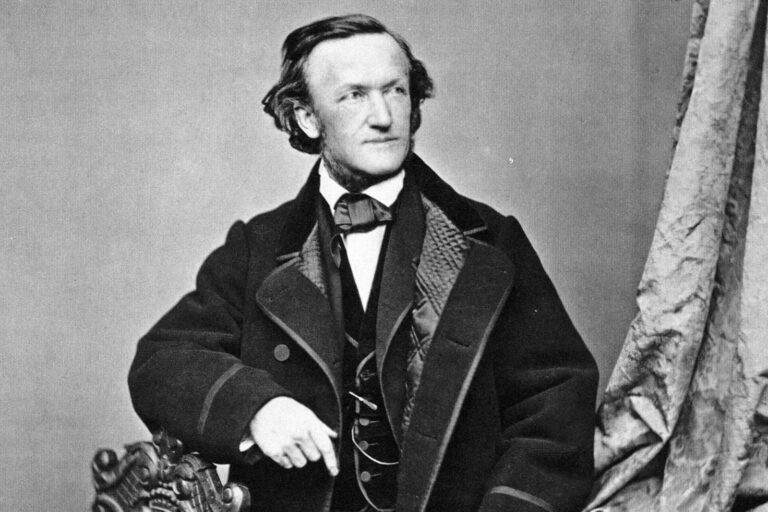
Romanticism · Germany and Austria
1813 – 1883
Leipzig - Venice
Review
He wrote his own books and transformed the opera into «musical drama», with continuous music woven from recurring motifs (leitmotiv). His participation in the 1849 Dresden revolution forced him to exile for years in Switzerland.
The support of King Louis II of Bavaria allowed him to build the Festspielhaus of Bayreuth, opened in 1876 with the ring of the complete nibelungo. His harmony, especially in Tristan and Isolda, opened the way to the music of the 20th century. His anti-Semitic writings today tarnish his figure.
His beginnings were difficult: he worked as director of provincial theatres and lived in Paris in misery before Rienzi's success in Dresden. Her sentimental life was as agitated as the professional, and in 1870 she married Cosima, daughter of Liszt. He spent his last years in his Wahnfried village of Bayreuth and died in Venice, at the Vendramin Palace, in 1883.
He conceived the opera as a «total work of art» where poetry, music, scene and myth are founded. His orchestra, huge and continuous, acts as a narrator who comments on what the characters do not say. His influence was enormous, both among his followers and among those who reacted against him. These are his main works:
I can INTEREST you.

Listen to it live
Next concerts with works by Richard Wagner at Spain
- Thu26NovBerklee a Les Arts: Ritual of the SwanBerklee Valencia · Dir. musical Albert Palau19: 30. · Les Arts, Teatre Martín i Soler · Valencia
- Fri27NovBerklee a Les Arts: Ritual of the Swan (2nd function)Berklee Valencia · Dir. musical Albert Palau19: 30. · Les Arts, Teatre Martín i Soler · Valencia
- Sat23JanABAO: Die Walküre de WagnerViktor Antipenko, Carla Filipcic-Holm, Egils Siliņš, Daniela Barcellona, Ángeles Blancas, Marko Mimica, Bilbao Orkestra Sinfonikoa, Pedro Halffter (director)19: 00. · Euskalduna Palace · Bilbao
- Mar26JanABAO: Die Walküre de WagnerViktor Antipenko, Carla Filipcic-Holm, Egils Siliņš, Daniela Barcellona, Ángeles Blancas, Marko Mimica, Bilbao Orkestra Sinfonikoa, Pedro Halffter (director)19: 30. · Euskalduna Palace · Bilbao
- Fri29JanABAO: Die Walküre de WagnerViktor Antipenko, Carla Filipcic-Holm, Egils Siliņš, Daniela Barcellona, Ángeles Blancas, Marko Mimica, Bilbao Orkestra Sinfonikoa, Pedro Halffter (director)19: 30. · Euskalduna Palace · Bilbao
Main works
- The wandering Dutch (1843 - 30 years old)
- Tannhäuser (1845 - 32)
- Lohengrin (1850 - 37 years old)
- Tristan and Isolda (1865 - 52 years old)
- The singers of Núremberg (1868 - 55 years old)
- Sigufrido's idol (1870 - 57 years old)
- The ring of the nibelungo, tetralogy (1876 - 63 years old)
- Parsifal (1882 - 69)

