Today 24 / 11 was born
- Anton Bruckner · 1824, 202 years ago
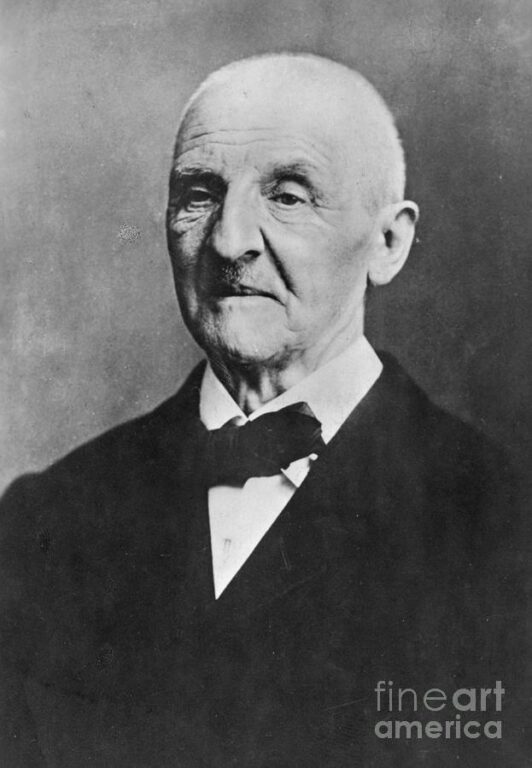
Romanticism · Germany and Austria
1824 – 1896
Ansfelden (Austria) - Vienna
Review
Anton Bruckner was born in 1824 in Ansfelden, a village in Upper Austria, the son of the school teacher and local organist. When his father died, in 1837, he entered the Augustino monastery of San Florian near Linz as a singer. That place, with its great organ and its liturgy, would mark its entire life: there he returned as a teacher and organist, and there he rests today, in the crypt under the organ.
For years he earned his life as a school teacher while becoming one of the best organists of his time, famous especially for his improvisations. In 1855 he obtained the organizational square of Linz Cathedral. That same year, over thirty years old, he began to study counterpoint by correspondence with Simon Sechter, Vienna's most severe theorist, and then form and orchestrate with Otto Kitzler. He did not complete his training until he was almost forty years old.
Kitzler discovered Wagner's music, and the meeting was decisive. In 1865 he attended the premiere of Tristan and Isolda, and from then on he venerated the composer without reservation. He dedicated his Third Symphony to him, and in the Seventh Adagio, written when he presented his death, he incorporated the Wagnerian tubs into a funeral lament. This devotion cost him a face in Vienna, divided between Wagner and Brahms supporters: the critic Eduard Hanslick was for decades his most relentless enemy.
Before the great symphonies came the three masses of the years of Linz (in re minor, my minor and fa minor), works of a deeply devoted Catholic who knew ancient polyphony as well as modern harmony. In 1868 he moved to Vienna to succeed Sechter as a professor of harmony and counterpoint in the conservatory; later he also taught at the university and was an organist of the imperial chapel. As an organ concerto he triumphed in Nancy, Paris and London.
The recognition as a composer took a long time. The opening of the Third in 1877, led by him, was a disaster: the public left the room and there were almost only a few young people, including Gustav Mahler. The success finally came with the Seventh, premiered in Leipzig in 1884 under the baton of Arthur Nikisch, when Bruckner was already sixty. Since then his fame grew in Germany and Austria, and in 1891 the University of Vienna granted him an honorary doctorate.
Unsure of the criticism and advice of friends and disciples, he reviewed his symphonies over and over again. When Director Hermann Levi did not understand the first version of the Eighth, Bruckner spent years redoing it. That is why many works exist several versions and editions, and choosing among them remains a decision of each director today.
His style is unmistakable. The symphonies are usually born of an almost inaudible trimolo from which a theme emerges, they advance through large sound blocks separated by silences, as if the organist changed record, and culminate in corals of metals of great strength. The scherzos have the rustic thrust of the Austrian peasant dances, and the adagios are among the most deep in the repertoire. That is why we have often talked about «symphonic cathedrals».
In his last years, already sick, Emperor Francis Joseph gave him a house in the Belvedere Palace. There he worked to the end in his Ninth, who dedicated «to the good God». He died in October 1896 leaving three movements finished and the finale in sketches; he himself had suggested that, if he did not complete it, his Te Deum should be interpreted instead. His heritage went directly to Mahler and the great symphonism of the 20th century.
I can INTEREST you.

Listen to it live
Next concerts with works by Anton Bruckner at Spain

