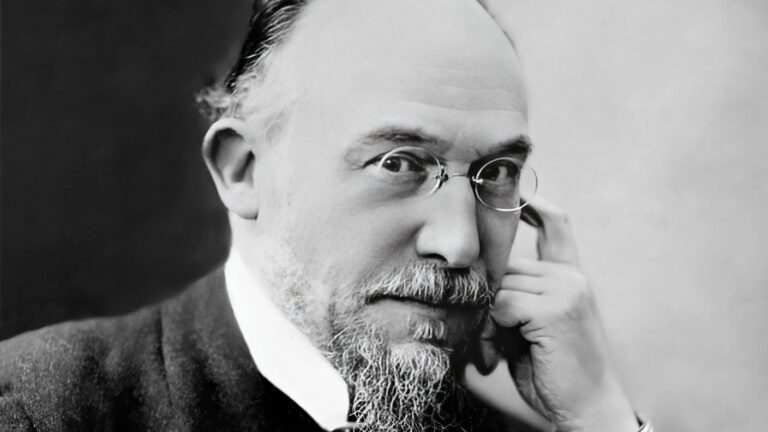
Impressionism · Precursor
1866 – 1925
Honfleur, France → Paris
Life
Erik Satie was born in Honfleur on the coast of Normandy on 17 May 1866, the son of a French maritime agent and a mother of British origin. After his mother's death he spent part of his childhood with his grandparents, received his first classes from a local organist and in 1878 met his father in Paris. At the Conservatory his teachers had him for a lazy and ungifted student, and he left him unfinished. In the late 1880s, he made a living as a pianist in the cabarets of Montmartre, starting with Le Chat Noir, and in those years he wrote the Sarabandes and Gymnopéies, with chords that are chained unsolved and that anticipate impressionist language.
By 1891 he met Claude Debussywith whom he maintained a long and sometimes difficult friendship; in 1896 Debussy orchestrated two of his Gymnopéies. Satie, however, soon turned away from impressionism and defended a simple, clear and humorous music, with scores sown with disparate indications for the interpreter. In 1898 he settled in Arcueil, on the outskirts of Paris, and in 1905, at the age of almost forty, he re-studied counterpoint at the Schola Cantorum with Vincent d'Indy and Albert Roussel. In 1911 Maurice Ravel He claimed it in public as a precursor, and the ballet scandal Parade (1917), with Cocteau and Picasso, made him a reference of the vanguard and godfather of the Group of Six. He died in Paris on 1 July 1925.
He was an eccentric and lonely character. In his youth he was an official composer of the mystical order of the Rosa- Cruz and came to find his own church, of which he was the only faithful. For years he always wore the same velvet suit, and later that of an official with a chocolate and umbrella. His only known love relationship was with painter Suzanne Valadon. After his death, his friends first entered his room in Arcueil and found two pianos, dozens of umbrella and many unpublished manuscripts.
His music is short, stripped and often ironic, with absurd titles and repetitions that challenge the idea of development. He invented the «furniture music», thought not to be listened to with attention, antecedent of environmental music. John Cage and the minimalists recognized him as one of his great precursors. These are his outstanding works:
Featured works
- Trois Sarabandes for piano (1887 - 21 years old)
- Trois Gymnopéies for piano (1888 - 22 years old)
- Gnossiennes for piano (h. 1890)
- Vexations for piano (h. 1893)
- Je te veux, waltz (1902 - 36 years old)
- Trois morceaux en forma de poirefor four-hand piano (1903 - 37 years old)
- Sports et divertissements for piano (1914 - 48 years old)
- Parade, ballet (1917 - 51 years old)
- Blow, symphonic drama (1918 - 52 years old)
- Relâche, ballet (1924 - 58 years old)

