Today 24 / 11 was born
- Maurice Ravel · 1875, 151 years ago
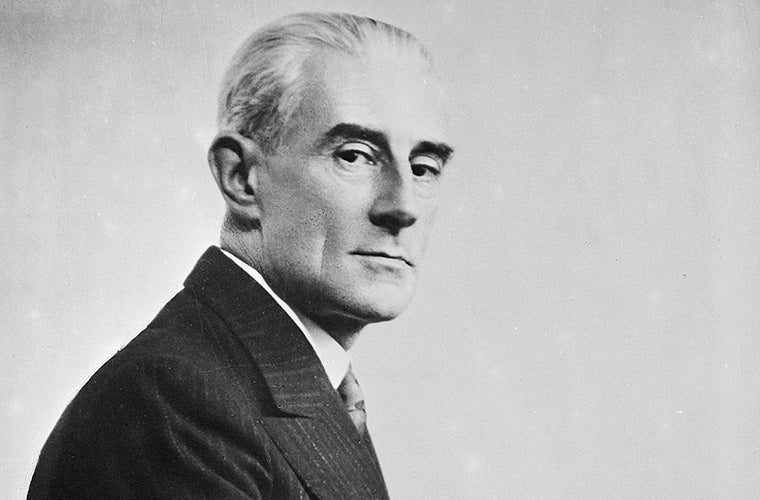
Impressionism · Main figures
1875 – 1937
Ciboure, France → Paris
Life
Maurice Ravel was born on March 7, 1875 in Ciboure, in the French Basque Country, as a Basque mother and a Swiss engineer father, and was raised in Paris. He studied at the Conservatory with Gabriel Fauré, and his repeated failure at the Prix de Rome ended in 1905 in a scandal that forced the director of the centre to resign. By that time I had already written the Pavane pour une infante défunte and Jeux d'eauOne of the pioneering works of the Impressionist piano.
Ravel shared with Debussy the taste for orchestral color and extended harmonies, but his music is more clear and in more classic forms; he was defined as a classic of new forms. Great orchestrator, with Daphne et Chloé took the orchestral impressionism to its summit, and its link with Spain goes through works such as the Rapsodie spagnole or Boléro. He died in Paris on December 28, 1937, after several years of neurological disease.
His father, an inventor passionate for the machines, gave him the taste for precision and mechanisms, which is noted in his music. In a small stature and always impeccably dressed, he never married and lived since 1921 in his house in Montfort-l'Amaury, full of mechanical toys and Japanese objects. In World War I, he served as a truck driver. In 1928 he made a triumphant tour of the United States, where he discovered jazz and met Gershwin.
He worked slowly and with extreme care, and his catalogue is relatively short, but almost all of it is often played. Many of his works exist in two versions, for piano and orchestra, and his orchestration of the squares of a Musorgski exhibition is the most famous. Jazz, dance and ancient French music appear over and over again in his work. These are his outstanding works:
I can INTEREST you.

Featured works
- Pavane pour une infante défunte (1899 - 24 years old)
- Jeux d'eau for piano (1901 - 26 years)
- String Quartet in fa major (1903 - 28 years)
- Miroirs for piano (1905 - 30 years)
- Rapsodie spagnole (1907 - 32 years old)
- Gaspard de la nuit (1908 - 33 years old)
- Ma mère l'Oo (1908-1911 - 33-36 years old)
- Daphne et Chloé, ballet (1912 - 37 years old)
- Le tombeau de Couperin (1917 - 42 years old)
- The fence (1920 - 45 years old)
- Boléro (1928 - 53 years old)
- Concert for piano in major sun (1931 - 56 years old)
Listen to it live
Next concerts with works by Maurice Ravel at Spain
- Mar24NovIgnis Quartet: Janáček and RavelIgnis Quartet19: 30. · National Auditorium, Chamber · Madrid
- Mar8DecMao Fujita, piano: «From clarity to fire»Mao Fujita (piano)19: 30. · Tenerife Auditorium Adam Martin - Chamber · Santa Cruz de Tenerife
- Thu10DecConfessions of the Soul: Ravel and Sibelius with the Atlantic Symphony OrchestraAtlantic Symphony Orchestra (ensemble), Isabel Costes (director), Ernesto Mateo (toy piano)20: 00. · Alfredo Kraus Auditorium · Las Palmas de Gran Canaria · Las Palmas
- Fri11DecTenerife Symphony: Symphony with Saint- Saint- Saint-Symphony of Tenerife; Karl-Heinz Steffens (director); Svetlin Roussev (violin); Juan de la Blubia (organ)19: 30. · Tenerife Auditorium Adam Martin - Symphony Room · Santa Cruz de Tenerife
- Fri11DecOFGC: French fantasy with Mikko Franck and Bruno DelepelairePhilharmonic Orchestra of Gran Canaria, Mikko Franck (director), Bruno Delepelaire (cello)20: 00. · Alfredo Kraus Auditorium - Symphony Room · Las Palmas de Gran Canaria · Las Palmas

