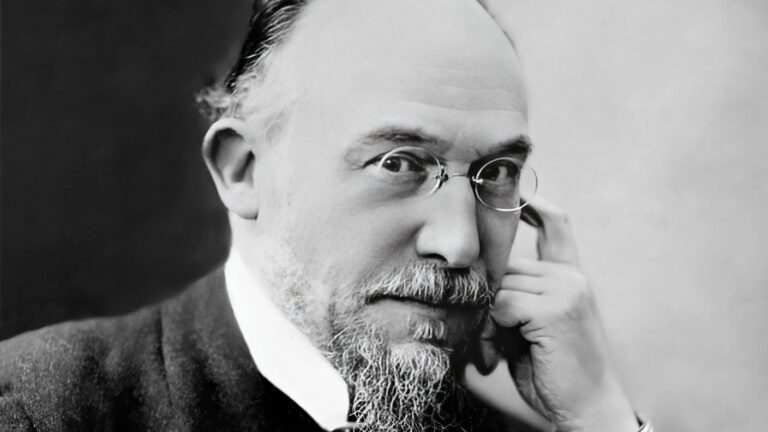
Erik Satie · Impressionism
1866 – 1925
1887 · Piano · Paris
Tonality
No fixed tonality: on a modal basis, Satie chain ninth chords that never come to be resolved.
Instruments
- Piano alone.
From the atril
Satie wrote all three Sarabandes in 1887, at twenty-one, when he began to move through the cabarets of Montmartre. It takes a slow and solemn dance of the Baroque, the zarabanda, and makes it something new: blocks of ninth chords that advance in parallel, as if each one was worth its own color and had to take nowhere.
That way of using harmony as color, and not as a way to a resolution, is the way Debussy and Ravel would develop years later. The three pieces were published together in 1911, the same year that Ravel played one of them at a concert of the Société musicale indépendante and presented Satie as an unjustly forgotten precursor.
What to hear
- The ninth chords in parallel that open the first zarabanda.
- The slow and ceremonial, almost liturgical, step of the three pieces.
- How each chord is heard for itself, without asking for resolution.
Listen
Erik Satie: Trois Sarabandes | Three Sarabandes (complete) · Alex Krasnoskulov
When you press the YouTube player will be loaded.

