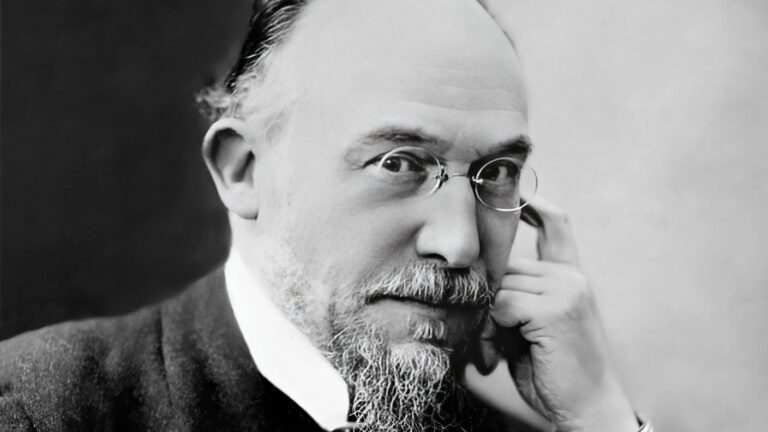
Erik Satie · Impressionism
1866 – 1925
1924 · Ballet · Théâtre des Champs-Élysées, Paris
Tonality
Tonal and direct, made of short motifs of popular song and cabaret that are repeated as in a collage.
Instruments
- Orchestra: wood, metals, percussion and rope.
- Includes the music of Entr'acte, the René Clair film that was projected between the two acts.
From the atril
Relâche, «Instantaneous ballet» In two acts, it was Satie's last work. He was born of his collaboration with Dadaísta painter Francis Picabia for the Swedish Ballets of Rolf de Maré, with choreography of Jean Börlin. The title means «No function», the sign that the theatres place when they close, and the joke became reality: the premiere, scheduled for the end of November 1924, had to be postponed for Börlin's disease and the public found the doors closed. It was finally released on December 4 at the Théâtre des Champs-Élysées.
Between the two acts it was planned Entr'acte, the film by René Clair in which Satie and Picabia himself appear, and for which Satie wrote one of the first flat-to-flat-thought scores for the cinema. His music, made of short motifs that are repeated with small variations, anticipates minimalism. Satie died seven months later, in July 1925.
What to hear
- The popular song motifs that come and go.
- The music of Entr'actewith his almost hypnotic repetitions.
- The dry mood and the total lack of solemnity, as a farewell of the composer.
Listen
Erik Satie, Relache, Cinema · naxosorchestral
When you press the YouTube player will be loaded.

