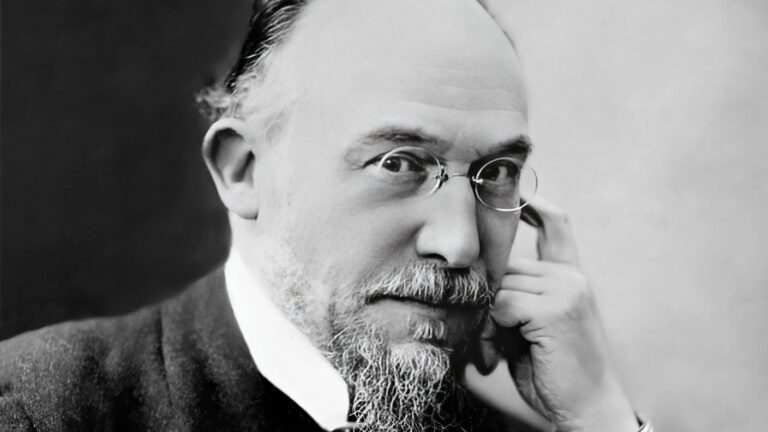
Erik Satie · Impressionism
1866 – 1925
1888 · Piano · Paris
Tonality
Modal. # 1 is measured between two chords of the seventh major, on the sun and on re, before it enters the melody.
Instruments
- Original: piano solo.
- Claude Debussy's orchestral version of No. 1 and 3 (1896).
From the atril
Satie composed all three of them. Gymnopéies in 1888, in his years of pianist in Montmartre. The title refers to the gimnopedes, a feast of the ancient Sparta in which the young people danced naked in honor of the gods. The three pieces are in three by four pairs, share almost the same form and carry twin indications: «slow and painful», «slow and sad» and «slow and severe».
Its simplicity is radical: a serene melody on a vaiven of chords that never accelerates or seeks climax. Debussy, Satie's friend, orchestrated the first and third in 1896, and that version helped make them known. Today the Gymnopédie # 1 is one of the most heard piano pieces in the world, present in concerts, films and ads.
What to hear
- The two-chord swing with which # 1 begins.
- The small differences between the three pieces, as a same object seen from three angles.
- The orchestral version of Debussy, which adds the color of the harp and the wood.

