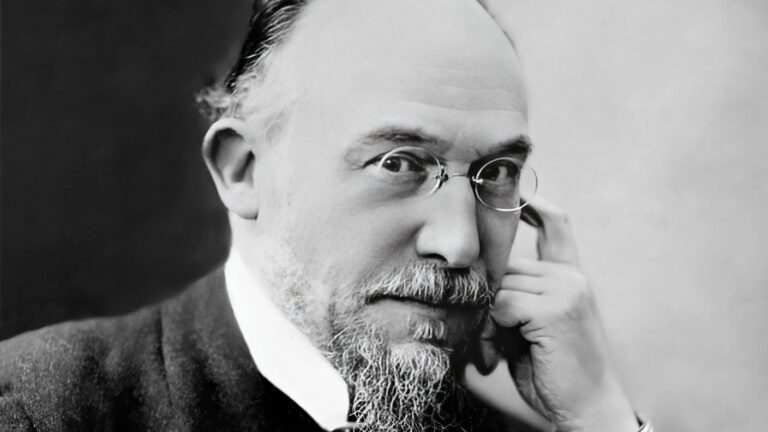
Erik Satie · Impressionism
1866 – 1925
1918 · Symphonic Drama · Paris
Tonality
Modal and sober, with static harmonies that accompany the text without stressing it.
Instruments
- Voices: one or more soprans.
- Camera Orchestra: wood, trumpet, trumpet, harp, timbals and rope.
- There is also a version for voice and piano.
From the atril
Princess Edmond de Polignac, a great musical patron of Paris, commissioned Satie in 1916 a work on Plato texts. Satie chose three passages from the dialogues, in the French translation of Victor Cousin: the portrait of Socrates in The banquet, the walk by the river Iliso del Fedro and the death of the philosopher narrated in the Fedon. It was finished in 1918 and first presented in private auditions; the public premiere arrived in 1920.
Far from the jokes of other works, Blow is Satie's most serious page, and he considered it his masterpiece. The voices recite the text in an almost neutral, undramatic way, about instrumental figures that are repeated calmly. The final account of Socrates' death, with a naked simplicity, is one of the most exciting moments of French music of his time.
What to hear
- The tone of quiet recitation of the voices, without theatrical effects.
- The orchestra's repeated figures on the walk next to the Iliso.
- The «Death of Socrates»with which the work is closed in a low voice.

