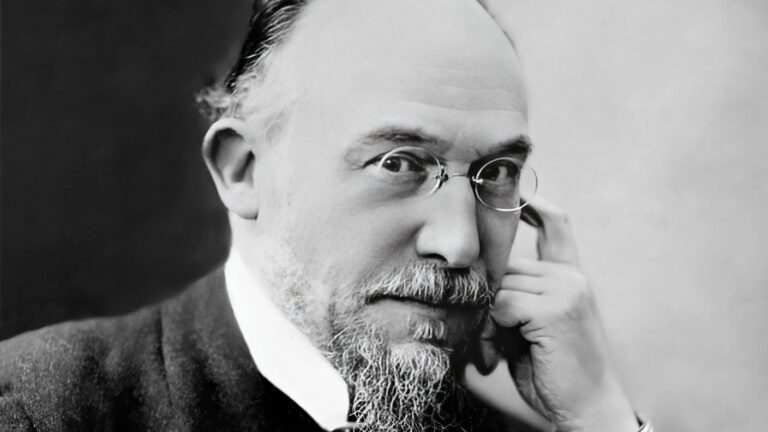
Erik Satie · Impressionism
1866 – 1925
1917 · Ballet · Théâtre du Châtelet, Paris
Tonality
Tonal but changing, with music-hall, ragtime and leaks that overlap without transition.
Instruments
- Symphonic Orchestra: wood, metals, percussion and rope.
- Sound effects: typewriter, gun shots, sirens, lottery wheel and a «botellophone».
From the atril
Parade It premiered on May 18, 1917 at the Théâtre du Châtelet in Paris, in the middle of the war, by the Russian Ballets of Serguéi Diáguilev, with the musical direction of Ernest Ansermet. The argument was by Jean Cocteau, the decorations and costumes of Pablo Picasso and the choreography of Léonide Massine. It shows some ferociantes who, in front of a circus bar, try unsuccessfully to attract the public to the interior show.
The street noises incorporated into the orchestra, the rhythms of ragtime and the Cuban suits of Picasso caused a memorable scandal. Guillaume Apollinaire wrote for the program a text in which he first used the word «surrealism». Parade He made Satie, at 50, the vanguard musician and the model of the young composers who would soon form the Group of Six.
What to hear
- The coral and the escape of the beginning, of an almost academic seriousness.
- The ragtime of the «American girl»with the typewriter and the shots.
- The short themes that are repeated as at a fair number.

