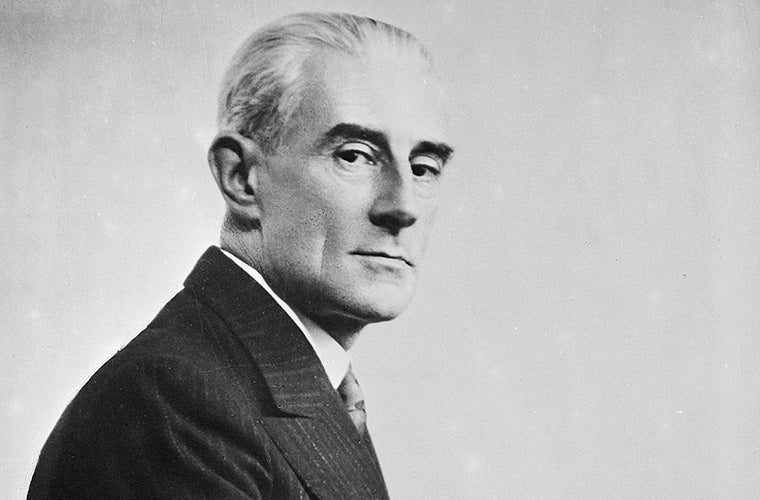
Maurice Ravel · Impressionism
1875 – 1937
1912 · Ballet · Paris, Russian Ballets
Tonality
Without a unique tone. Like all ballet, he goes through a lot of tonalities. The famous «Dawn» is in major.
From the atril
Daphne et Chloé, commissioned by Diáguilev for the Russian Ballets and premiered in Paris in 1912 with choreography of Fokine and Nijinski as protagonist, is the most extensive work of Ravel and the summit of orchestral impressionism. He himself defined it as a «choreographic symphony». It is based on Longo's Greek pastoral novel on the love of two young pastors.
The score, for a huge orchestra with no words, is of an incomparable timbrical wealth. The most famous moment is the «Dawn» of the third part: on a murmur of flutes, clarinet, harps and celesta that imitates the singing of the streams and birds, the severe cords make a wide melody slowly emerge that grows to a climax of dazzling light. He is followed by a pantomime with a famous flute solo, in which the pastors recreate the story of Pan and Siringa, and a «General dance» final, in five by four bars, frantic and rolling. The two orchestral suites, especially the second, are very much played in concert.
What to hear
- The «Dawn» part three.
- The flute solo of the pantomime.
- The «General dance» in five times four.

