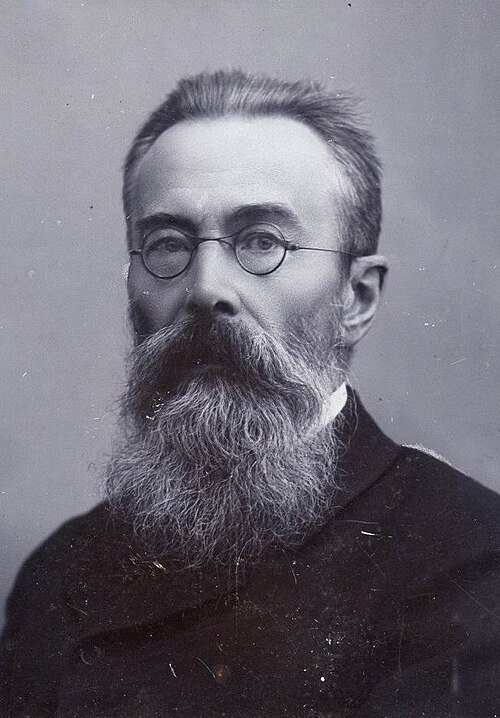
Nikolai Rimski-Korsakov · Romanticism
1844 – 1908
1888 · Symphony Suite · Saint Petersburg
Tonality
Without a unique tone. His four movements go through several tonalities, united by the theme of the soloist violin that embodies Scheherezade.
From the atril
Scheherezade, 1888, is the most famous work of Rimski-Korsakov. It is inspired by A thousand and a night.: Sultan Shahriar, convinced of the infidelity of women, marries a wife every night and executes her at dawn, until Scheherezade captures him by telling her stories for a thousand and one night. The suite has four movements, which the composer first titled and then preferred to leave without a title, so as not to lock up the imagination of the listener.
Two themes go through the whole work: that of the sultan, powerful and threatening, in the metals and the severe rope in unison; and that of Scheherezade, a sinuous melody of the violin only accompanied by the harp, which introduces each account. Among them are the sea and the ship of Simbad, the story of Prince Kalender, the idol of the young prince and the princess, and the feast of Baghdad that ends in a shipwreck. In the end, the subject of the Sultan is softened: the narrator has won. For the concert of the orchestra is one of the great solos of the repertoire, and for all musicians, a catalogue of orchestral colors.
What to hear
- Scheherezade's single violin with the harp.
- The sultan's threatening theme.
- The Baghdad party and the final shipwreck.

