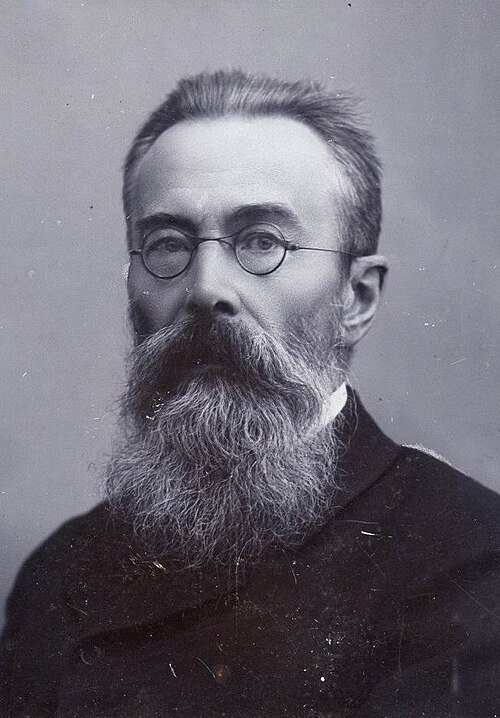
Nikolai Rimski-Korsakov · Romanticism
1844 – 1908
1887 · Orchestra · Saint Petersburg
Tonality
Without a unique tone. Its five parts, inspired by asturian and gypsy dances, go through several tonalities.
From the atril
Rimski-Korsakov first thought of a fantasy for violin and orchestra on Spanish themes, but he ended up writing, in 1887, a work for orchestra alone that is a color festival. The themes come from popular Spanish songs, in particular from Asturias, which he met through printed collections. During the essays, the musicians applauded the work so much that the composer dedicated it to them, and wrote their names on the score.
The work has five chained parts: a «Alborated» light, variations of pastoral character, the turn of the raging in another color, a «Scene and gypsy singing» and a «Fandango asturian» the end that accelerates to the frenzy. Its great merit is in orchestration: each instrument has its moment of mourning, with cadences for violin, flute, clarinet, harp and chestnut. Rimski-Korsakov said that orchestration was not an ornament, but the very essence of the work. For orchestra musicians it is a gift, and for the public, one of Spain's brightest views seen from outside.
What to hear
- The «Alborated» initial.
- The cadences of the «Scene and gypsy singing».
- The «Fandango asturian» end.
Listen
Rimskia-Kórsakov: Capricho espan-ol, op. 34 - Roberto Migulez- Monjas - Galicia Symphony Orchestra · SynphonicadeGalicia
When you press the YouTube player will be loaded.

