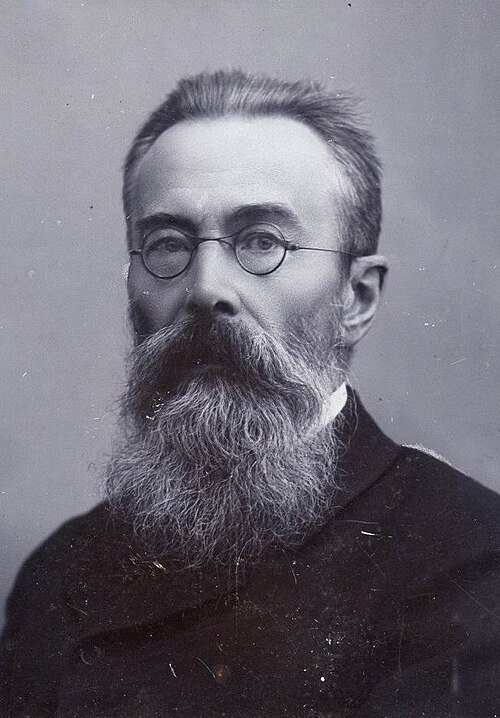
Nikolai Rimski-Korsakov · Romanticism
1844 – 1908
1888 · Oberture · Saint Petersburg
Tonality
No tonality indicated in the title. It is based on Russian Orthodox liturgical melodies.
From the atril
The overture The Great Russian Easter, completed in 1888, closes the orchestral trilogy that forms with the Spanish capricho and Scheherezade. Rimski-Korsakov dedicated it to the memory of his colleagues in the Group of Five Musorgski and Borodin. It is built on melodies of the Obijod, the collection of liturgical songs of the Russian Orthodox Church.
I can INTEREST you.

The work evokes the passage from the twilight of Good Friday to the explosion of joy on Easter morning. It begins with a slow and mysterious introduction, with a single of thrombon as a priest's recitation and a single of violin with a cadence air. Then the party comes: bells, dancing rhythms and an increasingly intense light. Rimski-Korsakov wanted to reflect both the religious solemnity and the almost pagan atmosphere of popular celebration. The orchestration is spectacular, with a very imaginative use of bells and metals. It's a play less touched than Scheherezadebut just as bright.
What to hear
- The thrombon solo as a recitative.
- The Orthodox liturgical songs.
- The bells of the final party.

