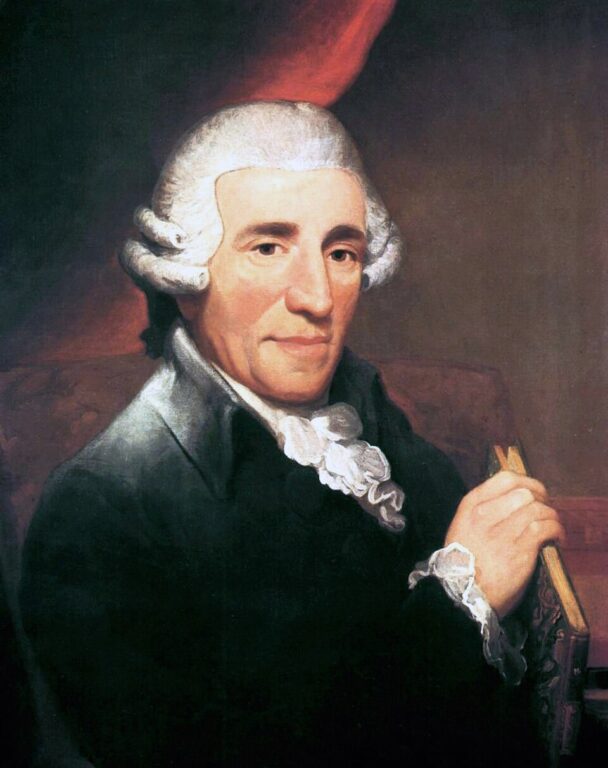
Joseph Haydn · Classification
1732 – 1809
1798 · Oratory · Vienna
Tonality
Without a unique tone. Like any other oratory, it goes through many tonalities: it starts with the «Representation of chaos» in minor and ends up in if bemol greater.
Instruments
- 3 flutes
- 2 oboes
- 2 clarings
- 2 fages and contrafagot
- 2 tubes
- 2 trumpets
- 3 thrombons
- Timbals
- Rope (violins, violas, cello and contrabajes)
- Continuous for the recites (fortepiano)
From the atril
In London, Haydn attended the great performances of the Handel oratoriums and was impressed. Back in Vienna, with a book based on Genesis and The Lost Paradise de Milton, adapted by Baron van Swieten, wrote The Creation, released in 1798. It was an immediate success and became the most loved work of his old age.
The work begins with one of the most bold pages of the time: the «Representation of chaos», an orchestral introduction of errant and undirected harmonies. Then when the choir sings «And the light was made.», the whole orchestra breaks out in a very large de do which remains an unforgettable blow. Throughout the work Haydn paints with the orchestra the rising sun, the moon, the storms, the roar of the lion, the flight of the birds or the worm that crawls. The chorus, like «The heavens proclaim the glory of God»They are of a contagious joy.
What to hear
- The «Representation of chaos».
- The outbreak of «And the light was made.».
- The choir «The heavens proclaim».
Listen
Haydn: The Creation | Nederlands Kamerkoor, Concerto D'Amsterdam & Klaas Stock (2009) · DW Classical Music
When you press the YouTube player will be loaded.

