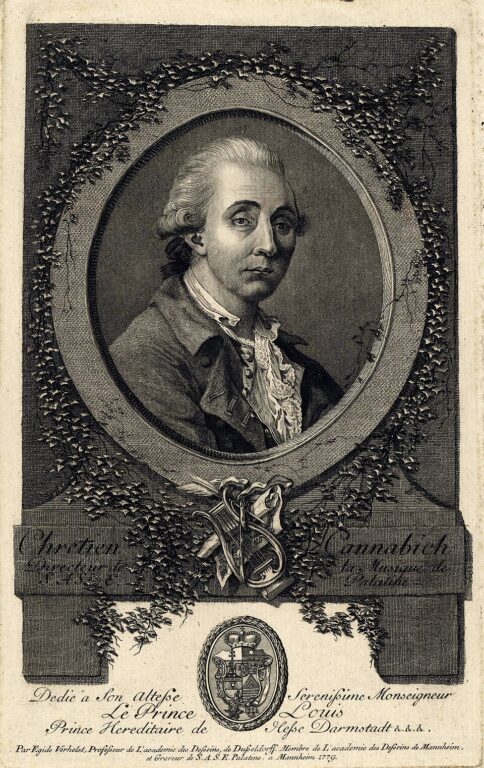
Christian Cannabich · Classification
1731 – 1798
c. 1750 - 1798 · More than 70 symphonies · Mannheim and Munich
Tonality
Without a unique tone. Cannabich wrote dozens of symphonies and each has his own.
Instruments
- Row
- Flutes, oboes and fages
- Thrombas
- In some, trumpets and timbals
From the atril
Cannabich was, above all, a legendary orchestra director. Under his baton, or rather since his first violin atrial, the Mannheim orchestra achieved a discipline and precision that astonished the travelers: the English historian Charles Burney described it as a «army of generals». His more than seventy symphonies were written for that exceptional set.
Playing them is learning how a great 18th-century orchestra sounded. Cannabich writes thinking of the effect: very marked dynamics, long crescends, impeccable simultaneous attacks, wood that dialogue with the rope. Mozart, who spent several months in Mannheim in 1777 and 1778, deeply admired this orchestra and learned much from what he would then apply in his symphonies. These works are the link between the late Baroque and the great Viennese symphonism.
What to hear
- Mannheim's dynamic crescends and contrasts.
- The independent role of wood.
- The accuracy of the orchestral attacks.

