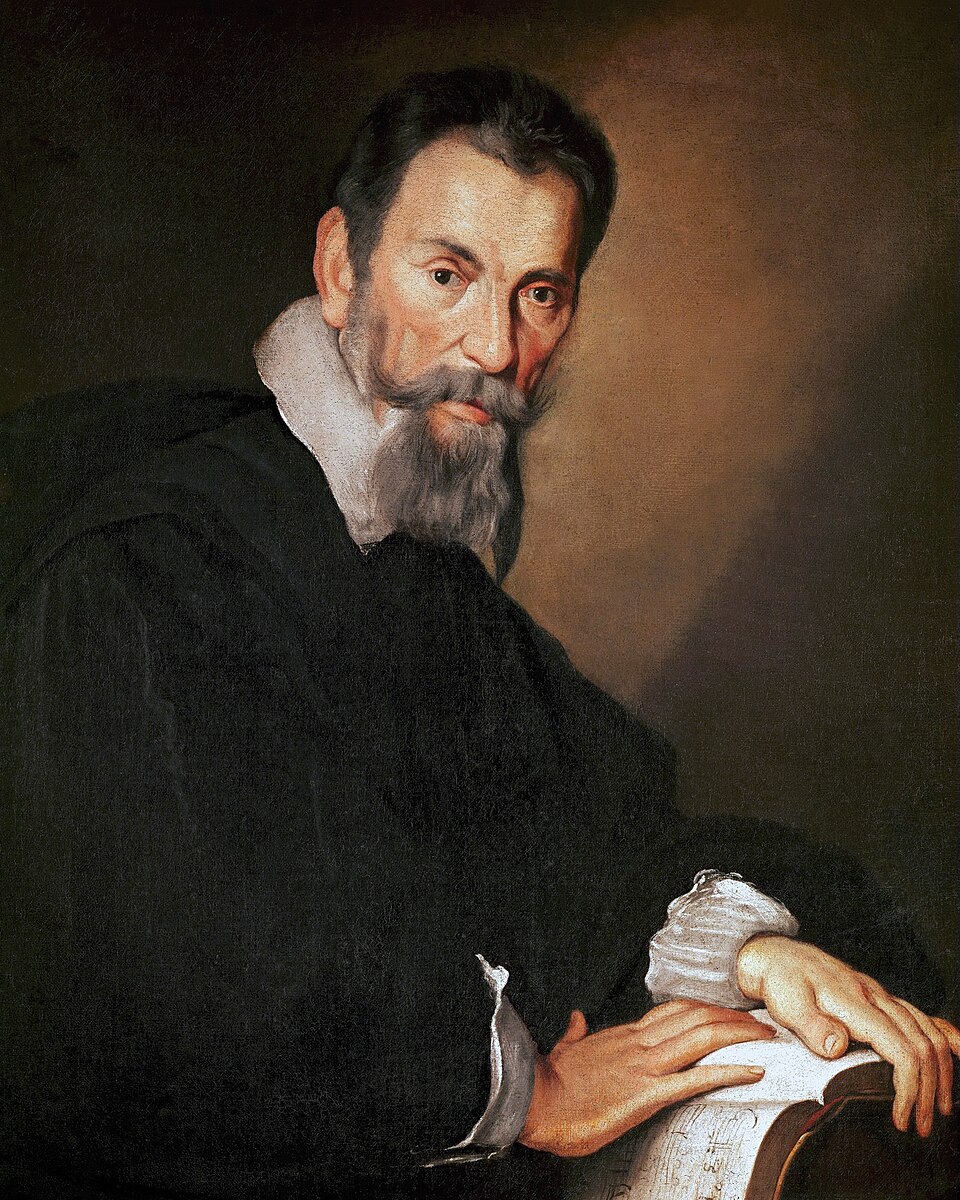
Baroque · Italy
1567 – 1643
Cremona - Venice
Review
At the service of the Gonzaga in Mantua, it premiered in 1607 L'Orpheus, the first great opera in history. He defended a «second practice» in which music should serve the expression of the text, breaking with the rules of the Renaissance.
From 1613 he was a chapel master of the Basilica of Saint Mark of Venice. He already wrote for the first public opera theatres of the city Il riviron d'Ulisse in país and L'incoronazione di Poppea.
Son of a doctor from Cremona, he formed with Marc 'Antonio Ingegneri, chapel master of the cathedral, and published his first collection at only fifteen years. Your defense of the «second practice» It was worth the attacks of the theorist Giovanni Artusi, to whom he responded with increasingly bold music: expressive, recitative disonances and a dramatic use of the instruments. The death of his wife in Mantua and later the plague of 1630 marked his life; in 1632 he was ordained a priest.
His work summarizes the passage from Renaissance to Baroque. In the eight books of madrigal you can follow this evolution, from the polyphony to five voices to the madrigal with continuous bass and almost theatrical. The Vespers of 1610 bring to the church the splendor of the new music, and its three preserved operas, from Orpheus to The Coronation of Popea, remain the starting point of the genre. These are his main works:
I can INTEREST you.

Listen to it live
Next concerts with works by Claudio Monteverdi in Spain
Main works
- L'Orpheus Opera (1607 - 40 years old)
- Sorry d'Arianna (1608 - 41 years old)
- Vespro della Beata Vergine (1610 - 43 years old)
- Eight books of madrigals (1587-1638 - 20-71 years)
- Il combattimento di Tancredi e Clorinda (1624 - 57 years old)
- Selva morale e spirituale (1641 - 74 years old)
- Opera Il ricor d'Ulisse in país (1640 - 73 years old)
- Opera L'incoronazione di Poppea (1643 - 76 years old)

