Contemporary · 20th century
1906 – 1975
St. Petersburg, Russia → Moscow
Life
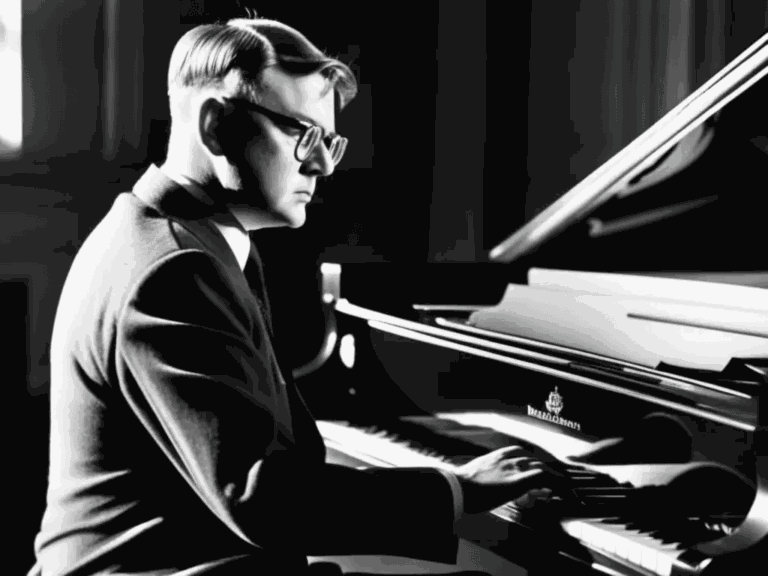
Dmitri Shostakovich (also written as Shostakovich) was born in St. Petersburg on September 25, 1906. His mother, a pianist, gave him the first classes, and at the age of 13 he entered the Petrograd Conservatory, then directed by Alexandr Glazunov, where he studied piano with Leonid Nikoláyev and composition with Maximilian Steinberg. To pay for the studies, he played the piano in the city's silent cinemas. Su First symphonywritten as an end-of-career job and premiered in 1926, when he was nineteen, he immediately turned the world around by directors like Bruno Walter and Leopold Stokowski.
His life was marked by his relationship with the Soviet power. In January 1936, days after Stalin attended a Lady Macbeth of Mtsensk, the diary Pravda attacked the opera in the editorial «Chaos instead of music». Shostakovich withdrew his Fourth symphonywhich would not be released until 1961, and recovered the official favor with the Fifth (1937). During World War II, the Seventh, «Leningrad», became a symbol of resistance to the Nazi siege. In 1948 the Zhanov decree again accused him of «formalism»: lost his place in the conservatory, much of his works stopped being interpreted and kept in the drawer scores like the First concert for violin.
I can INTEREST you.

After Stalin's death in 1953, the Tenth symphony and a somewhat freer stage, although never without pressure: in 1960 he joined the Communist Party. His musical signature, the DSCH motif (re, my bemol, do, if in the German notation), goes through many of his works. He wrote fifteen symphonies, fifteen quartets of rope, concerts, operas, ballets and abundant film music, with a language that goes from sarcasm and the most agacious irony to desolate lyrism. With health very weakened in his last years, he died in Moscow on August 9, 1975 and is buried in the cemetery of Novodévichi. It is, next to Prokofiev, the great Russian composer of the 20th century and one of the most interpreted symphonists of our time.
Main works
- Symphony No. 1 (1926 - 20 years old)
- Lady Macbeth Opera of Mtsensk (1934 - 28 years old)
- Symphony No. 5 (1937 - 31 years old)
- Symphony No. 7 «Leningrad» (1942 - 36 years old)
- Concert for violin No. 1 (1948 - 42 years old)
- 24 Preludios and leaks, for piano (1951 - 45 years)
- Symphony No. 10 (1953 - 47 years old)
- Concert for piano No. 2 (1957 - 51 years old)
- Concert for cello no. 1 (1959 - 53 years)
- String Quartet No. 8 (1960 - 54 years)
- Vals No. 2, of the Suite for the orchestra of varieties

