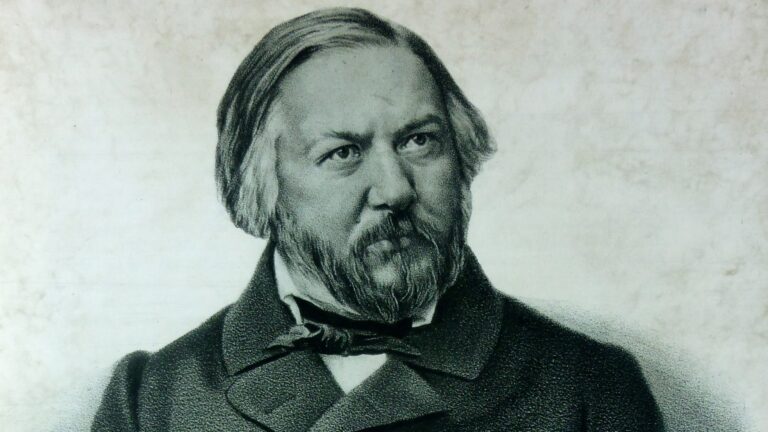
Mijail Glinka · Romanticism
1804 – 1857
1842 · Opera · Saint Petersburg
Tonality
Without a unique tone. Like every opera, it goes through a lot of tonalities. Your dizzy overture is in major.
From the atril
Ruslan and Liudmila, released in 1842, is based on a youth poem by Aleksandr Pushkin, an epic fairy tale. The gentleman Ruslan must rescue his fiancée Liudmila, the daughter of the great prince of Kiev, kidnapped by the evil wizard Chernomor, on a journey full of adventures, magic and enchantments.
The opera was received coldly at its premiere, but had a huge influence on the later Russian composers, who found in it a model of fantasy, oriental exotism and colorist orchestration. It is famous for its overture, one of the most brilliant of the repertoire, with a very fast theme on the strings that tests the agility of any orchestra and that is played constantly in concert. The opera also highlights the march of Chernomor, of grotesque humor, and the eastern dances of the fourth act, with exotic scales that anticipate Borodin and Rimski-Korsakov. The Chernomor theme uses a scale of whole tones, something very new for the time.
What to hear
- The overture, very fast on the ropes.
- The Chernomor march.
- The eastern dances of the fourth act.
Listen
Glinka: Ouvertüre zu »Ruslan und Ludmilla« ∙ hr-Sinfonieorchester ∙ Andrés Orozco-Estrada · hr-Sinfonieorchester - Frankfurt Radio Symphony
When you press the YouTube player will be loaded.

