Today 24 / 11 was born
- Frédéric Chopin · 1810, 216 years ago
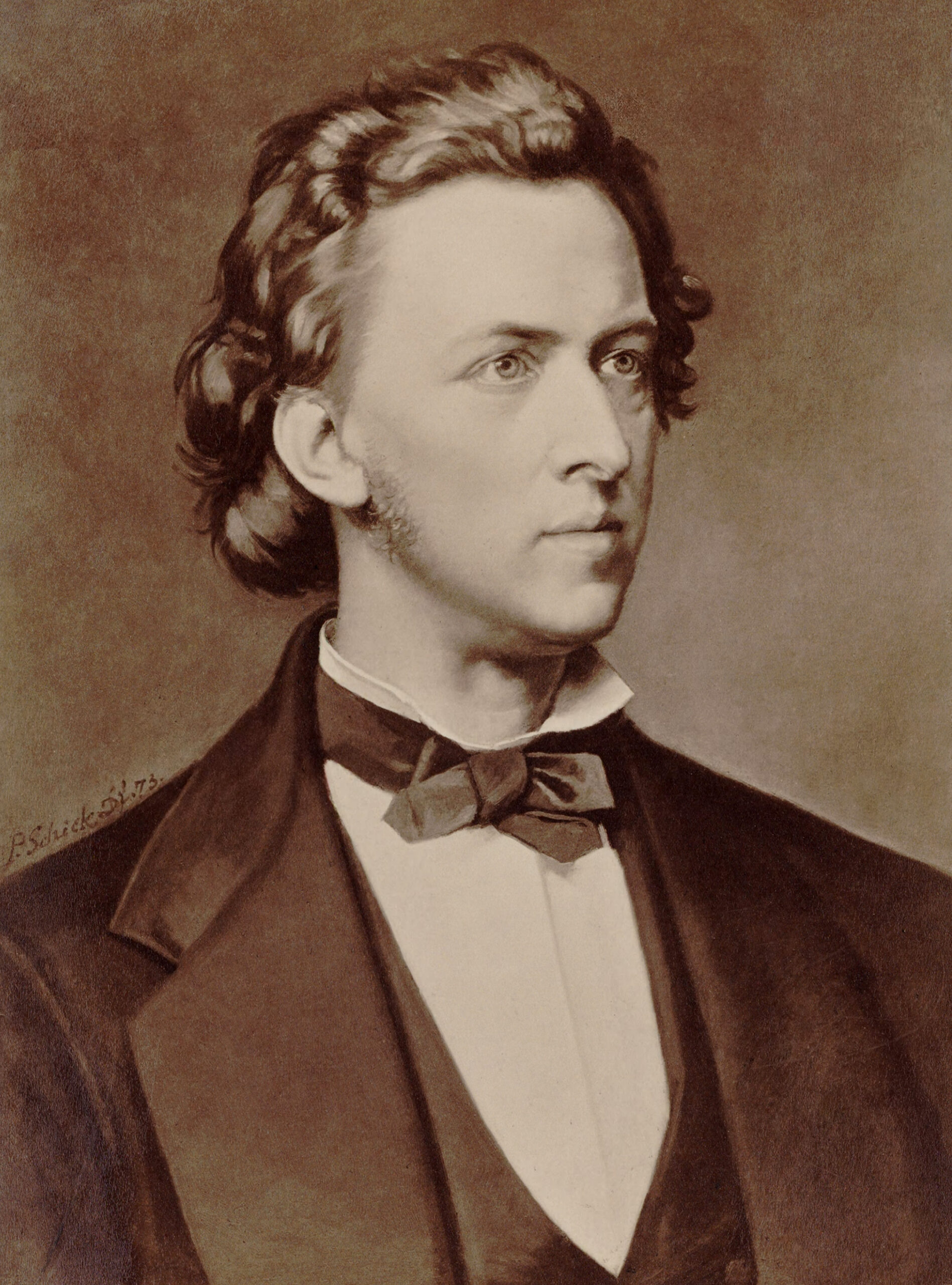
Romanticism · The romantic piano
1810 – 1849
Śelazowa Wola (Poland) - Paris
Review
Child prodigy in Warsaw, left Poland in 1830, shortly before the uprising against Russia, and would no longer return. Since 1831 he lived in Paris, where he taught and played mainly in private rooms.
He wrote almost exclusively for piano and completely renewed his language. He lived a long relationship with the writer George Sand, with whom he spent the winter of 1838-1839 in the Cartja de Valldemossa (Mallorca), where he finished his Preludios. He died of tuberculosis at the age of 39.
Son of a French preceptor based in Poland and a Polish mother, he was formed at the Warsaw Conservatory with Józef Elsner, who was able to respect his originality rather than to frame it. At the age of twenty he had already written his two piano concerts, and in 1831 Robert Schumann greeted his Variations op. 2 with a phrase that made fortune: «Take off your hat, gentlemen: a genius!».
His style is born of singing. Admiral of Bellini and Italian opera, makes the piano «breathe» as a voice: long melodies and ornamented on a flowing accompaniment, a refined use of the pedal and the famous tempo rubate, in which the right hand is taken freedoms while the left hand holds the pulse. His other great devotion was Bach: the 24 Preludios go through all the tonalities, as the well-tempered key, and he himself played Bach before each concert.
Poland never left its music. The mazurcas and polonesses raise the dances of their land to pianistic poetry, loaded with nostalgia and national pride. At the same time he invented or transformed whole genres: the ballad as a great instrumental account, the scherzo became an independent dramatic piece and the nocturnal one, inherited from the Irish John Field, led to an unknown honour. He played in public very few times —just 30 concerts in his whole life— and preferred the privacy of the living room and the Pleyel pianos.
The stay in Mallorca, in the winter of 1838-1839, sought sun and rest for his health and discretion for his relationship with George Sand, who was traveling with his two children. The reality was another: they arrived in Palma in November, the rains did not stop, Chopin worsened and, for fear of contagion, they had to leave Son Vent's house. They were then installed in a cell of the Valldemossa Cartel, uninhabited since the decriminalization of 1835. The Pleyel piano he expected was held in customs weeks and had to be composed with a modest Mallorcan piano until he arrived in January. However, among those wet walls he finished the Preludios op. 28 and advanced on Balada n. 2, Scherzo n. 3 and Polonesas op. 40; from there also comes the legend of the Preludio. «Water drop». In February 1839 they left the island, with Chopin very ill. George Sand said it, without much love to the mallorquins, in A winter in Mallorca; today the cell of Valldemossa is museum and preserves the Pleyel piano.
After the break-up with George Sand in 1847, his health sank. In 1848 he traveled to England and Scotland invited by his student Jane Stirling and gave his last concert in London, for the benefit of Polish refugees. He died in Paris on October 17, 1849; at his funeral, at the Madeleine church, the Mozart Réquiem sounded. He is buried in the Père-Lachaise cemetery, but his heart, of his own desire, was taken to Warsaw by his sister Ludwika and lies in the church of the Holy Cross.
I can INTEREST you.

Listen to it live
Next concerts with works by Frédéric Chopin in Spain
- Mar24NovPaul Lewis, piano: Mozart, Schubert and ChopinPaul Lewis (piano)19: 30. · Tenerife Auditorium Adam Martin - Chamber · Santa Cruz de Tenerife
- Sat28NovCSMA: Chopin jazz, with Noel RedolarNoel Redolar (piano)19: 00. · Superior Conservatory of Aragon Music · Zaragoza
- Fri11DecEldar Nebolsin, piano: Enescu, Chopin, Helps and ProkophievEldar Nebolsin19: 30. · Bilbao Philharmonic Society · Bilbao
- Mon14DecBOS Great soloists in recital: Claire HuangciClaire Huangci (piano)19: 30. · Euskalduna Palace · Bilbao
- Sat19DecMusicaixa: «The Intimitat of Romanticism»Timeless Trio: Raúl Arias, violin · Santiago Pla, trump · Judith Kertesz, piano · Pedro Altava, piano19: 00. · Caixa Rural Burriana event hall (C / La Carrera, 17) · Burriana · Castellón

