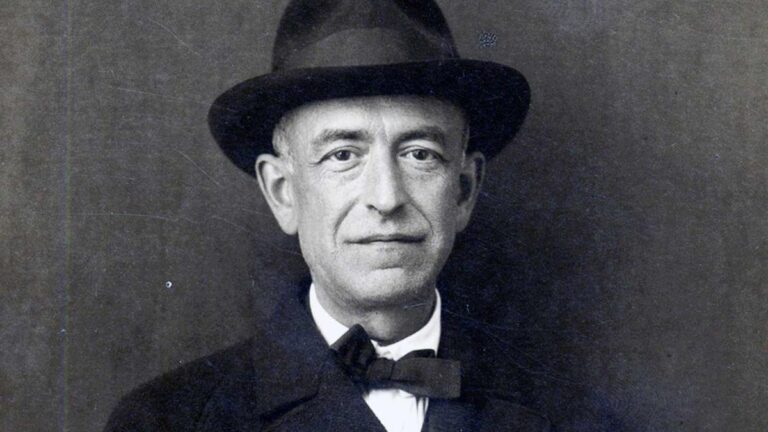
Manuel de Falla · Impressionism
1876 – 1946
1919 · Ballet · London, Russian Ballets
Tonality
Without a unique tone. Like all ballet, he goes through many tonalities along his dances.
From the atril
The three-peak hat It was released in London in 1919 by the Russian Ballets of Diáguilev, with choreography of Léonide Massine and decorated and dressed by Pablo Picasso: one of the brightest artistic collaborations of the 20th century. It is based on the novel by Pedro Antonio de Alarcón, who in turn collected a popular story.
The story is a farce: a vain cordiator, who wears the three-peak hat symbol of his authority, tries to seduce the beautiful mill, but she and her husband, the mill, make him fall into ridicule. Falla writes a score full of humor, rhythm and color, based on popular dances from all over Spain. The orchestral suites are very touched in concert: the «Mill Dance» (a fandango), the «Mill Dance» (an extremely intense farruca, which begins with a call of a trumpet and a single of English corno) and «Final dance», a jota which demands an extraordinary energy and rhythmic accuracy from the orchestra.
What to hear
- The mill's farruca.
- The mill fandango.
- The final boot.

