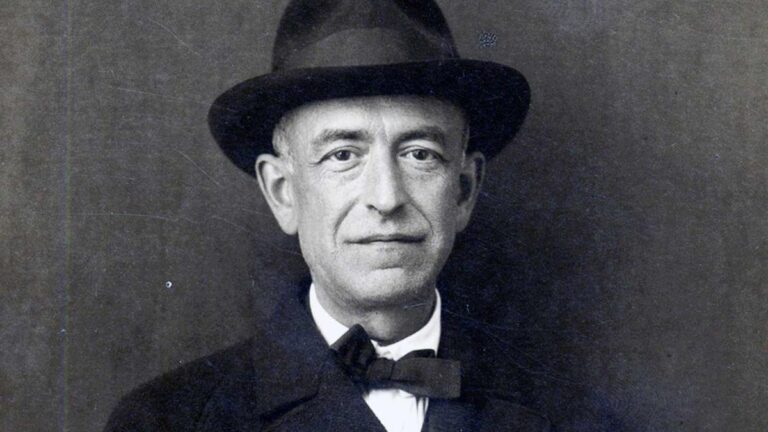
Manuel de Falla · Impressionism
1876 – 1946
1916 · Piano and orchestra · Madrid
Tonality
Without a unique tone. Its three parts go through several tonalities, with modal turns of Andalusian music.
From the atril
Falla defined Nights in the gardens of Spain how «symphonic prints for piano and orchestra». It is not a concert in the traditional sense, but three night paintings in which the piano is integrated into the orchestra as one more instrument, with moments of starring. It began in Paris under the influence of Debussy and ended in Spain in 1916.
The first move, «In the Generalife», evokes the gardens of the Alhambra of Granada: the fountains, the cypresses, the moon, with an orchestra of soft and mysterious colors and a piano that murmurmurs and flashes. The second, «Distance dance», bring the echoes of a party that is heard far away. And the third, «In the gardens of the Sierra de Córdoba», it breaks into a gypsy zambra full of energy, which leads to a passionate ending and then goes out at night. It is the work in which the Andaluciism of Falla and French impressionism are most naturally founded. For the pianist, it requires a palette of very rich colors rather than virtuosism.
What to hear
- The fountains and the moon of «In the Generalife».
- The far-off echoes of the «Distance dance».
- The gypsy zambra of the third movement.

