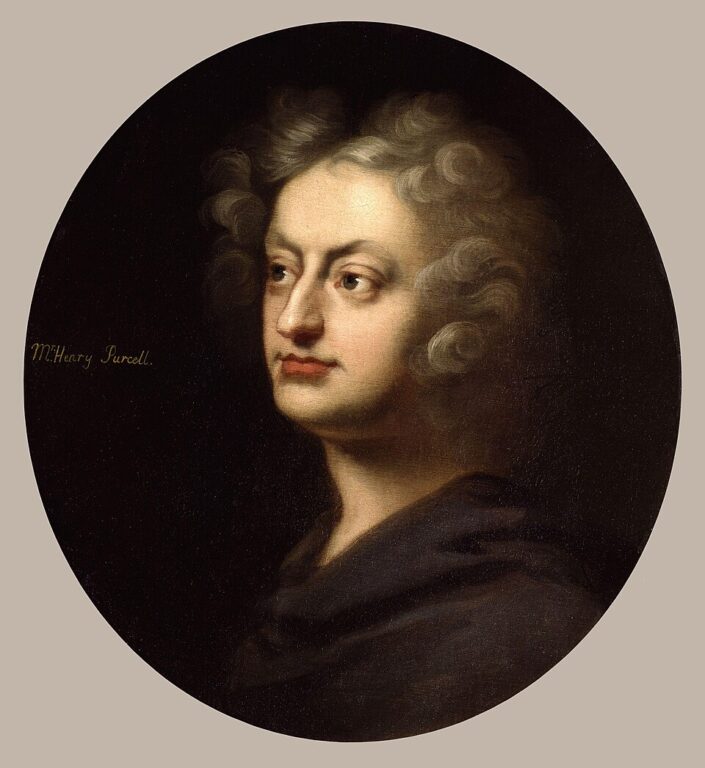
Henry Purcell · Baroque
1659 – 1695
c. 1688 · Opera · London
Tonality
Without a unique tone. Like every opera, it goes through a lot of tonalities. Dido's final lament, «When I am laid in earth», is in smaller sun.
Instruments
- Rope (2 violins, viola and bass)
- Under continuous (key; the book also mentions a guitar)
From the atril
Dido and Eneas It is an opera of just an hour with a curious story: Purcell's only life-documented representation took place in a young ladies' boarding school in Chelsea, that of Josias Priest, about 1689, although it may have premiered earlier in court. Nahum Tate's libretto summarizes book IV of the Eneida: The queen of Cartago falls in love with the Trojan Eneas, who abandons her to fulfill her destiny.
Despite its modest dimensions, each scene is perfect. Purcell adapts music to the English language as no one, alternates cutting chorus, dances and scenes of sinister witches, and concentrates emotion in a few minutes. Everything leads to the end: Dido's lament, «When I am laid in earth», built on a descending chromatic bass that is repeated over and over as the voice rises above. Your request «Remember me» and the final chorus, with the coupids spreading roses on his grave, are of the most moving pages of the entire opera.
What to hear
- «Ah! Belinda», the first aria of Dido, also on an obstinate bass.
- The witch scenes, in sinister humor.
- The lament «When I am laid in earth» And the final choir.

