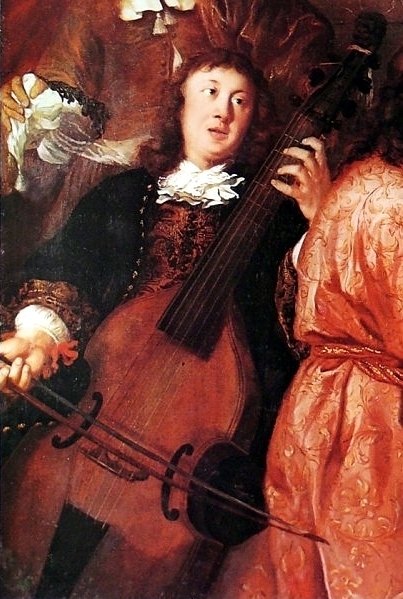
Dieterich Buxtehude · Baroque
c. 1637 - 1707
1680 · Seven cantons for voices and instruments · Lübeck
Tonality
Without a unique tone. They are seven cantons, one for each part of Christ's body, and each has his own.
Instruments
- 2 violins
- Violone
- 5 violas da gamba (only in the sixth cantata, Ad cor)
- Continuous low (organ)
From the atril
It is the most famous vocal work of Buxtehude: seven short Latin cantons, each dedicated to a part of Christ's body on the cross, from the feet to the head: feet, knees, hands, side, chest, heart and face. The texts come from a medieval poem of meditation on the Passion. Buxtehude dedicated the manuscript to his friend Gustav Düben, a musician of the Swedish court, thanks to whom he has preserved himself.
Each cantata follows a similar scheme: an instrumental sonata, a chorus on a biblical verse, several aria for soloists and the repetition of the chorus. But within that regularity there is a huge variety of colors. The most special moment for the instrumentalists is the sixth cantata, Ad corto the heart, in which the violins give way to a set of violas gives gamba of veiled and intimate sound. It is music of deep devotion, without any external dramatism.
What to hear
- The instrumental sonatas that open each cantata.
- The sixth cantata, Ad cor, with the pool of violas.
- The Amen end of the seventh cantata.
Listen
Tebra Jesu Nostri - Dieterich Buxtehude | Pinchgut Opera | Full Performance · Pinchgut Opera
When you press the YouTube player will be loaded.

