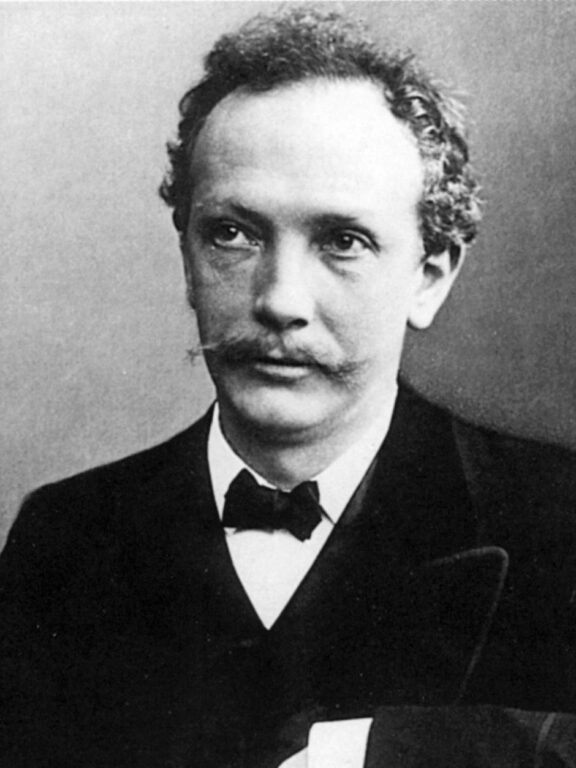
Richard Strauss · Romanticism
1864 – 1949
1890 · Symphonic poem · Eisenach
Tonality
Do minor. The final transfiguration comes in a light major.
From the atril
Death and Transfiguration, released in 1890, is not based on any literary work: it is an argument imagined by Strauss himself, who was only 25 years old. He describes the last hours of a sick artist who, on his deathbed, remembers his childhood, his youth and his struggles, before dying and achieving transfiguration, the realization of the ideals he could not fulfil in life.
I can INTEREST you.

The work begins in the gloom of the room, with an irregular rhythm that evokes the patient's tired breathing. They follow the memories, tender and bright, and the attacks of the fever, violent. In the end, after the last breath, the theme of transfiguration slowly arises, which grows in a great luminous crescendo of the whole orchestra. Almost sixty years later, on his own deathbed, Strauss commented that dying was exactly as he had composed it in this work, and in his last four songs he cited this same theme. It is a music of great nobility, which demands the orchestra patience and amplitude of sound.
What to hear
- The irregular rate of the patient's breathing.
- The memories of childhood.
- The final theme of the transfiguration.
Listen
A. Strauss: Tod und Verklärung Op. 24 · Berliner Philharmoniker
When you press the YouTube player will be loaded.

