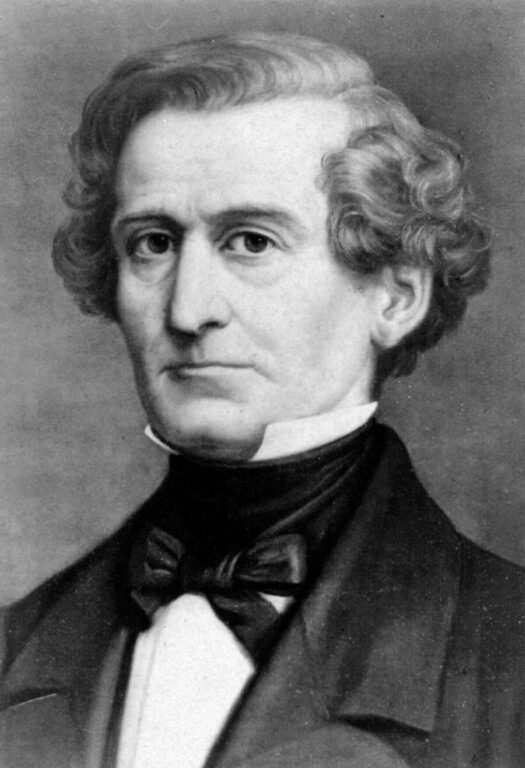
Hector Berlioz · Romanticism
1803 – 1869
1837 · Réquiem · The Invalids, Paris
Tonality
Without a unique tone. Its different parts go through several tonalities.
From the atril
The French State ordered Berlioz a réquiem in memory of the victims of the 1830 revolution. The ceremony was cancelled, but the work ended in December 1837 at the church of the Invalids of Paris, at the funeral of General Damrémont, who died in Algeria. Berlioz later said that if he had to save one of his works, he would save this one.
Its fame is due to its dimensions: a great choir, a huge orchestra, sixteen timbals and four groups of metals placed on the four corners of the temple. In «Tuba mirum» These groups enter one after another from all directions and the effect, live, is overwhelming: the Final Judgment surrounding the listener. But the most admirable thing about the work is its opposite. Much of the Réquiem is intimate, almost naked, and Berlioz seeks unusual combinations, as in the «Hostias», where a few acute flutes respond to the thrombons in their most serious record, with an immense vacuum between them. The «Sanctus» for tenor is only of a serene beauty.
What to hear
- The «Tuba mirum», with all four groups of metals.
- The «Hostias»with severe flutes and thrombons.
- The «Sanctus»for tenor alone.

