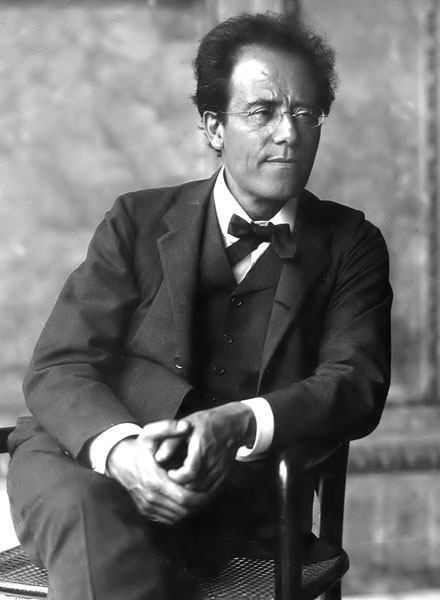
Gustav Mahler · Romanticism
1860 – 1911
1910 · Symphony with soloists, choirs and orchestra · Munich
Tonality
From the atril
Mahler wrote the Octave in a single summer, the 1906, in his maiernigg cabin, almost in a trance state. He premiered it himself in Munich in September 1910, with over a thousand performers between giant orchestra, two mixed chorus, children's choir, eight soloists and organ. The concert entrepreneur announced it as «Symphony of the thousand», a nickname that Mahler didn't like but that stayed. It was the greatest success of his life, a few months before he died, and he dedicated it to Alma.
I can INTEREST you.

It has two parts that seem to have nothing to do with the medieval Latin anthem. Veni Creator Spirit and the final scene of Faust Goethe. What unites them is the idea of the creative force and the love I redeem. The first part starts with an organ chord and the entrance to full lung of the chorus, and is almost a counterpoint cathedral. The second begins in a low voice, with a long orchestral prelude that evokes a mountain landscape, and advances for almost an hour until the Chorus mystius, «Alles Vergängliche ist nur ein Gleichnis», which grows from a piansimo barely audible to a dazzling end with additional metals.
What to hear
- The entry of the organ and the choirs in «Veni Creator Spirit».
- The orchestral prelude of the second part.
- The Chorus mystius end.

