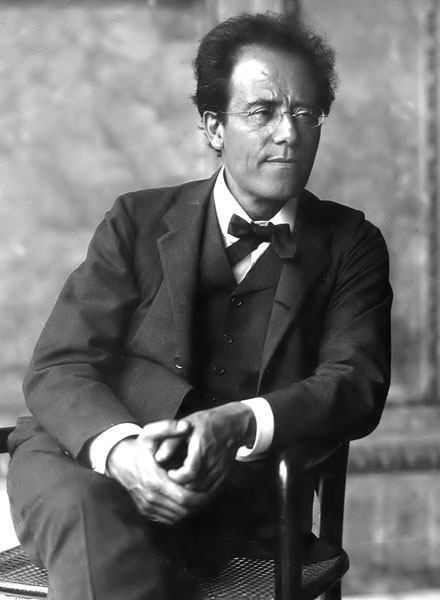
Gustav Mahler · Romanticism
1860 – 1911
1909 · Symphony of songs · Premiere in Munich, 1911
Tonality
Without a unique tone. It's six songs and each one has his own. The work fades at the end over a chord of major.
From the atril
Das Lied von der Erde was born after the worst year of Mahler's life, 1907: his eldest daughter died, he was diagnosed with a heart disease and left the Vienna Opera. In 1908 he found comfort in The Chinese flute, a free version of Hans Bethge of ancient Chinese poems, Li Bai and other authors. It is actually a symphony for tenor, contralt and orchestra, but Mahler avoided calling it «Ninth», fearing it was the last, as it had been for Beethoven or Bruckner. He did not hear it: it was released by Bruno Walter in Munich in November 1911, six months after his death.
I can INTEREST you.

His six songs alternate the tear and light. The first is a báquica song about the misery of the earth, of tremendous writing for the tenor; the plants paint delicate scenes, almost of porcelain, with pentatonic scales and a transparent orchestra. It all comes out in «Der Abschied»the farewell, which lasts almost as long as the previous five together. In the end the contralt repeats «ewig... ewig» (eternally) on the celesta, harp and mandolin, in a chord that never ends. The music, more than finished, fades away.
What to hear
- «Das Trinklied vom Jammer der Erde»with the initial tube.
- «Von der Jugend», of an oriental lightness.
- The last few minutes of «Der Abschied»with his «ewig» end.
Listen
Diemecke speaks of Mahler - The Song of the Earth (Das Lied von Erde) · Mahler Society
When you press the YouTube player will be loaded.

