Today 24 / 11 was born
- Giuseppe Verdi · 1813, 213 years ago
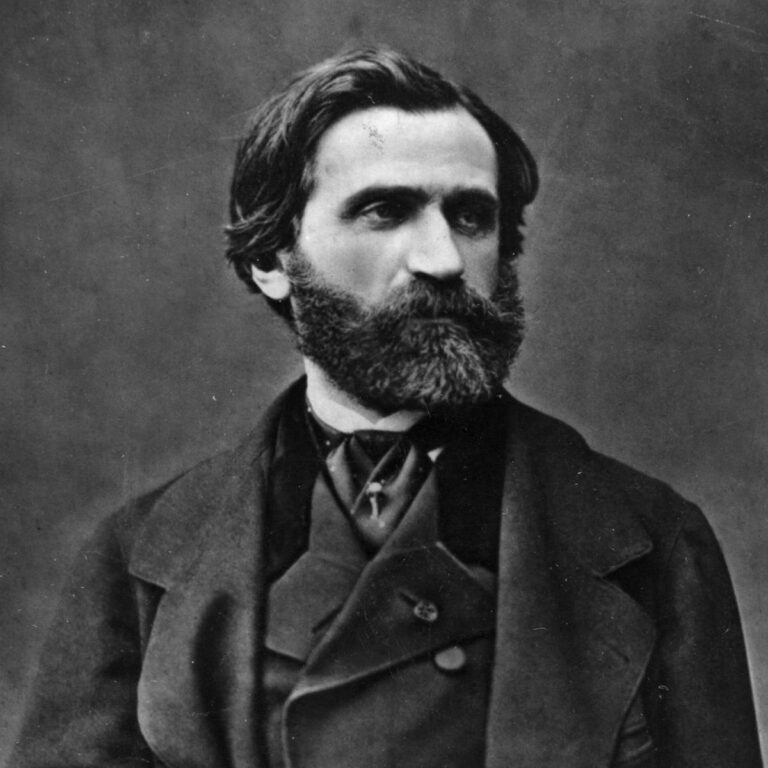
Romanticism · Italy
1813 – 1901
Le Roncole (Busseto) - Milan
Review
Rejected by the conservatory of Milan, he succeeded in 1842 with Nabucco, whose choir «Come on, asshole.» became a symbol of Italian unification. Between 1851 and 1853 Rigoletto, Il trovatore and La traviata premiered.
His theatre revolves around intense human passions and unforgettable characters. The old man, with Arrigo Boito as a librettist, signed two masterpieces inspired by Shakespeare: Otello and Falstaff. He founded a residence for old musicians in Milan.
Son of an inn of a village on the Po plain, he formed in Busseto thanks to the support of the merchant Antonio Barezzi, with whose daughter Margherita married. His wife and two children died in a very short time, and he was about to leave the music before Nabucco's success. He then shared his life with the soprano Giuseppe Strepponi. He was a member of the first Italian Parliament and a passionate farmer in his Sant'Agata estate.
He wrote twenty-eight operas, and his evolution is amazing: from the patriotic chorus and the horse of his early years to the dramatic continuity of Otello and the lightness of Falstaff. His Réquiem brings theatrical strength to religious music. His death was a national duel. These are his main works:
I can INTEREST you.

Listen to it live
Next concerts with works by Giuseppe Verdi in Spain
- Mar24NovXXIV Tribute to Alfredo Kraus: Jorge de León and the OFGCJorge de León (tenor), Orquesta Philharmonica de Gran Canaria, Karel Mark Chichon (director)19: 00. · Alfredo Kraus Auditorium - Symphony Room · Las Palmas de Gran Canaria · Las Palmas
- Wed25NovOperaLovers Mode ONJury Pillar · Orchestra della Scala Aretina · dir. Miquel Ortega19: 30. · National Music Auditorium, Symphony Room · Madrid
- Sun20DecIl trovatore de Verdi: Municipal Band of LleidaMunicipal Band of Lleida; Choirs; Espai Dansa19: 00. · Auditori Municipal Enric Granados, Room 1 · Lleida
- Sun27DecEnd of Year Concert: Symphony Orchestra of Ponferrada and BierzoOrchestra Symphony of Ponferrada and Bierzo, Manuel Alejandre (director), Inés Ananda (soprano)20: 00. · Municipal Auditorium of Ourense · Ourense
Main works
- Nabucco (1842 - 29 years old)
- Rigoletto (1851 - 38 years old)
- Il trovatore (1853 - 40 years old)
- La traviata (1853 - 40 years old)
- An in-house ballet (1859 - 46 years old)
- Don Carlos (1867 - 54 years old)
- Aida (1871 - 58 years old)
- Mass of Réquiem (1874 - 61 years old)
- Otello (1887 - 74 years old)
- Falstaff (1893 - 80 years old)

