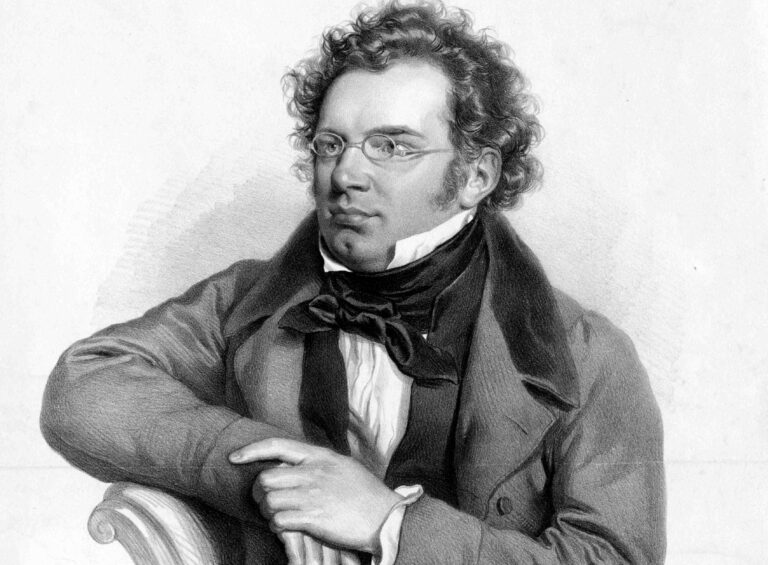
Franz Schubert · Romanticism
1797 – 1828
1822 · Symphony · Vienna
Tonality
From the atril
Schubert completed two movements of this symphony in his own minor and left a third, a scherzo, which never ended. No one knows why. The manuscript passed to his friend Anselm Hüttenbrenner, who kept it for decades, and the work was not released until 1865, more than forty years after its composition.
From the orchestra, it begins with one of the most mysterious beginnings in history: cello and contrabajos alone, pianissimo, in the grave record, as a question in the dark. Then, on a murmur of the strings, oboe and clarinet sing a restless theme, and later comes the famous melody of the cello, tender and balanced. The contrasts are violent, with explosions from the whole orchestra. The second movement is of an almost unreal serenity. The two parts form a whole so perfect that we don't miss the rest.
What to hear
- The mysterious beginning of the bass.
- The melody of the cello of the first movement.
- The serenity of the second movement.

