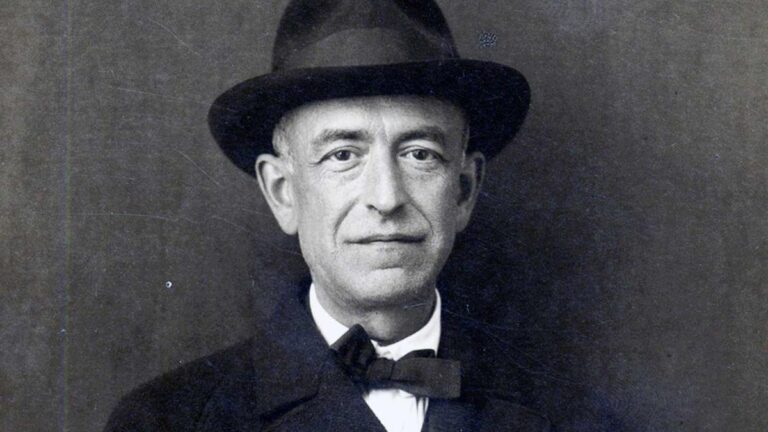
Manuel de Falla · Impressionism
1876 – 1946
1923 · Puppet opera · Paris
Tonality
Without a unique tone. Like every opera, it goes through many tonalities, with modal turns of ancient Spanish music.
From the atril
The altarpiece of Maese Pedro was commissioned by the princess of Polignac, mecenas of the musical avant-garde, for the theatre of her Paris palace, where it premiered in 1923. Falla took an episode of Stay down.: Don Quixote assists in a sale to a puppet function about Melisendra's release, and, confusing fiction with reality, destroys the altarpiece to save the characters.
The work marks a turn in the style of Falla: it leaves behind the Andaluciism and the impressionist color to look to the ancient Spanish music, the romances and the music of Castilla, with a more austere and neoclassical writing. The orchestra is reduced, camera, and includes a key, which at the premiere Wanda Landowska played, and gave foot to the Concert for later key. One of the papers, that of the Trujaman that tells the story, is written for a soprano child, with a very characteristic archaic style decline. It is a short, half-hour, fascinating work in its mixture of humor, nobility and modernity.
What to hear
- The voice of the Trujaman, sung by a child.
- The key to the camera orchestra.
- Don Quixote's final intervention.

