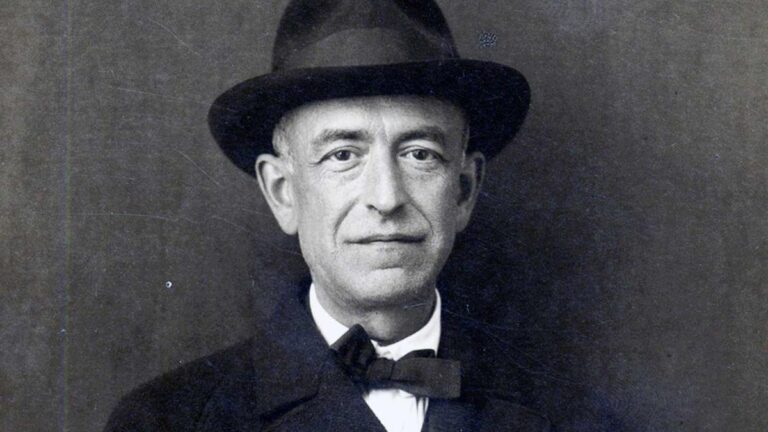
Manuel de Falla · Impressionism
1876 – 1946
1926 · Key and five instruments · Barcelona
Tonality
No tonality indicated in the title. Its harmony, often polytonal, is inspired by the Spanish music of the Golden Century.
From the atril
After working with Wanda Landowska in The altarpiece of Maese Pedro, Falla wrote for her this concert, premiered in Barcelona in 1926. It was one of the first modern concerts for key, an instrument that Landowska was resurrecting after more than a century of oblivion, and is the most radical and concentrated work of Falla.
The template is of camera: key, flute, oboe, clarinet, violin and cello, all treated as soloists. It's only 13 minutes long. The first movement, rough and energetic, cites a Spanish song from the 15th century. The second, the heart of the work, is a solemn and serious slow, which Falla associated with the procession of Corpus Christi in Seville, with chords of the key that sound like bells. The end, on the other hand, is bright and danced, with rhythms that evoke Scarlatti. It is a dry music, without ornaments, far from the Andalusian postcards: the Neoclassical Fault in pure state. For the clavecinist it is a demanding work, of great rhythmic strength.
What to hear
- The Spanish song of the first movement.
- The bells of the slow central.
- Scarlatti's rhythms at the end.

