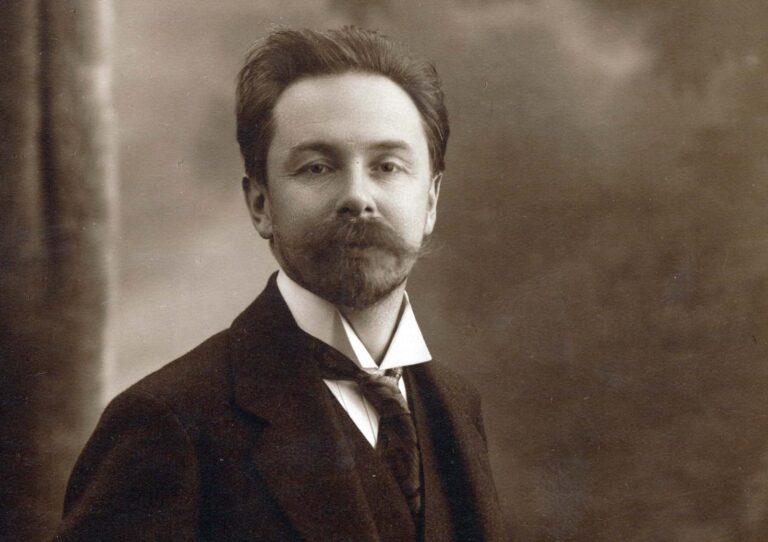
Alexander Scriabin · Impressionism
1872 – 1915
1911 · Piano alone · Moscow
Tonality
No tonality in the traditional sense. It belongs to the last stage of Scriabin, in which it left the major - minor system for its own harmonies.
From the atril
Scriabin called her «White Mass» And he said it was his favorite sonata: a sacred, luminous, purifying ceremony. It is in one movement, like all its late sonatas, and has already abandoned traditional tonality. The harmony revolves around mysterious chords that are repeated as a mantra, in an atmosphere of rite and bells.
For a pianist it is one of the most difficult to read scores of the entire repertoire: in the culminating moments Scriabin writes in four pentagrams to be able to score everything that happens, with trines, chords and superimposed melodies. The indications of character in French are poetic: «with a dazzling joy», «like a whirlwind». But the most difficult thing is not the technique, but to make that density sound transparent, as if the piano emits light. The end dissolves in a trino in the acute, as a fading vision.
What to hear
- The chords repeated as bells of a rite.
- The passages written in four pentagrams, of orchestral density.
- The end, it evaporates in the acute record.

