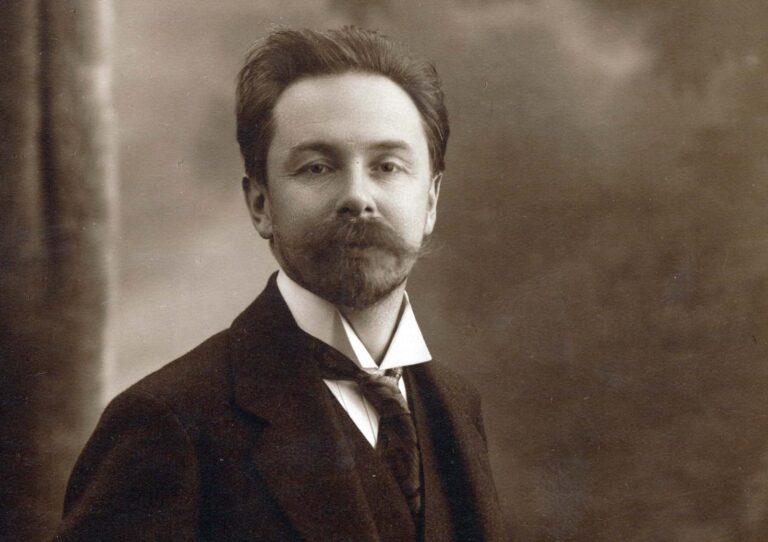
Alexander Scriabin · Impressionism
1872 – 1915
1910 · Piano, orchestra, organ, choir and lights · Moscow
Tonality
No tonality in the traditional sense. The whole work is built on «mystic chord», a six-note chord invented by Scriabin. Only the final chord is resolved in major sustained.
From the atril
In the first line of the score there is an instrument that does not sound: the It looks, a «keyboard of lights» that was to inundate the room with colors synchronized with harmony. Scriabin associated each tone with a color and wanted a total experience of sound and light. At the premiere, in Moscow in 1911, the apparatus did not work, and the first performance with lights was made in New York in 1915, shortly before his death.
The whole work is born of a single chord, the call «mystic chord» or «Prometheus chord», built by quarters. From it comes the melodies, the harmonies and even the color. From the soloist piano, which here is more of a character of the orchestra than a protagonist, the feeling is to play within a nebula that is gradually illuminated to the final explosion in a greater sustained fa, with chorus without words. It is one of the most visionary works of the early 20th century.
What to hear
- The «mystic chord» The one who starts it all.
- The piano integrated into the orchestra as one more voice.
- The final climax with chorus and the major sustained fa chord.
Listen
Scriabin: Promethée, le poème du feu, Op. 60 · Alexander Toradze
When you press the YouTube player will be loaded.

