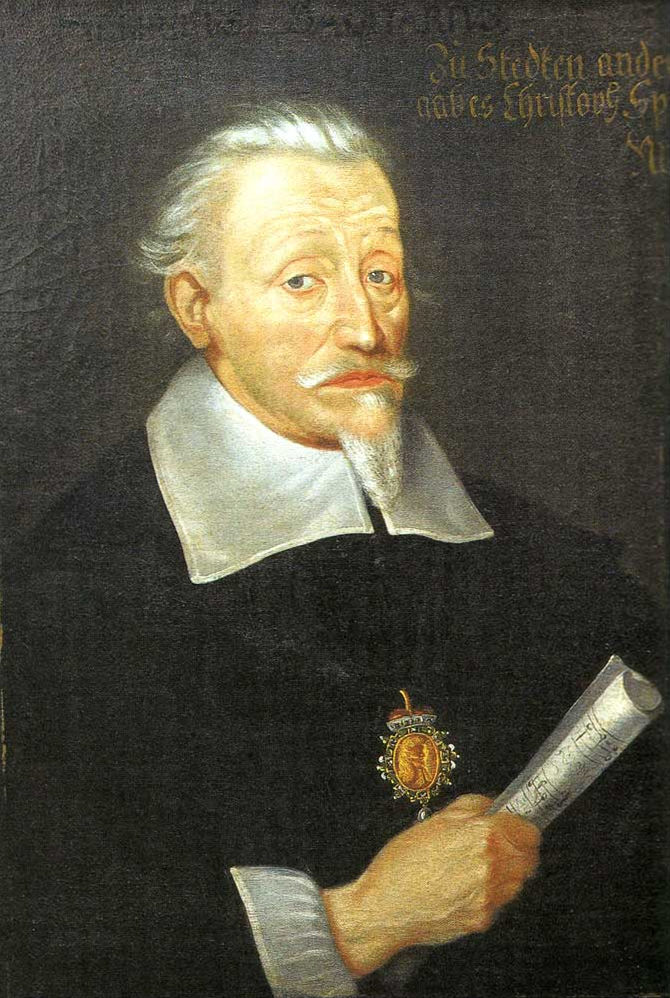
Heinrich Schütz · Baroque
1585 – 1672
1636 · Funeral music · Gera
Tonality
No tonality in a modern sense. It is modal music from the first half of the 17th century, in three parts with its own character.
Instruments
- Continuous bass (organ and violone)
From the atril
To the Musikalische Exequien («musical exequies») were born of a very particular order. Prince Heinrich Posthumus Reuss prepared his own funeral years in advance: he chose the biblical texts and hymn verses he wanted to be recorded in his coffin, and asked Schütz to put music on them. The prince died in 1635 and the work was performed in his burial at Gera in February 1636.
It is, in practice, the first réquiem in German, although it does not follow the mass of the deceased Catholic. It has three parts. The first, the most extensive, alternates passages for soloists and chorus with an almost camera delicacy. The second one is a short to double chorus. In the third, Schütz has a great idea: while a choir sings the song of Simeon, «Herr, nun lässsest du deinen Diener», a second group of voices, located at a distance, «Blessed are the dead who die in the Lord»As if it came from the beyond. In the middle of the Thirty-Year War, it is a music of extraordinary comfort.
What to hear
- The first part, «Concert in Form einer teutschen Begräbnis-Missa».
- The double chorus motor «Herr, wenn ich nur dich habe».
- The end, with the far choir of «Selig sind die Toten».

