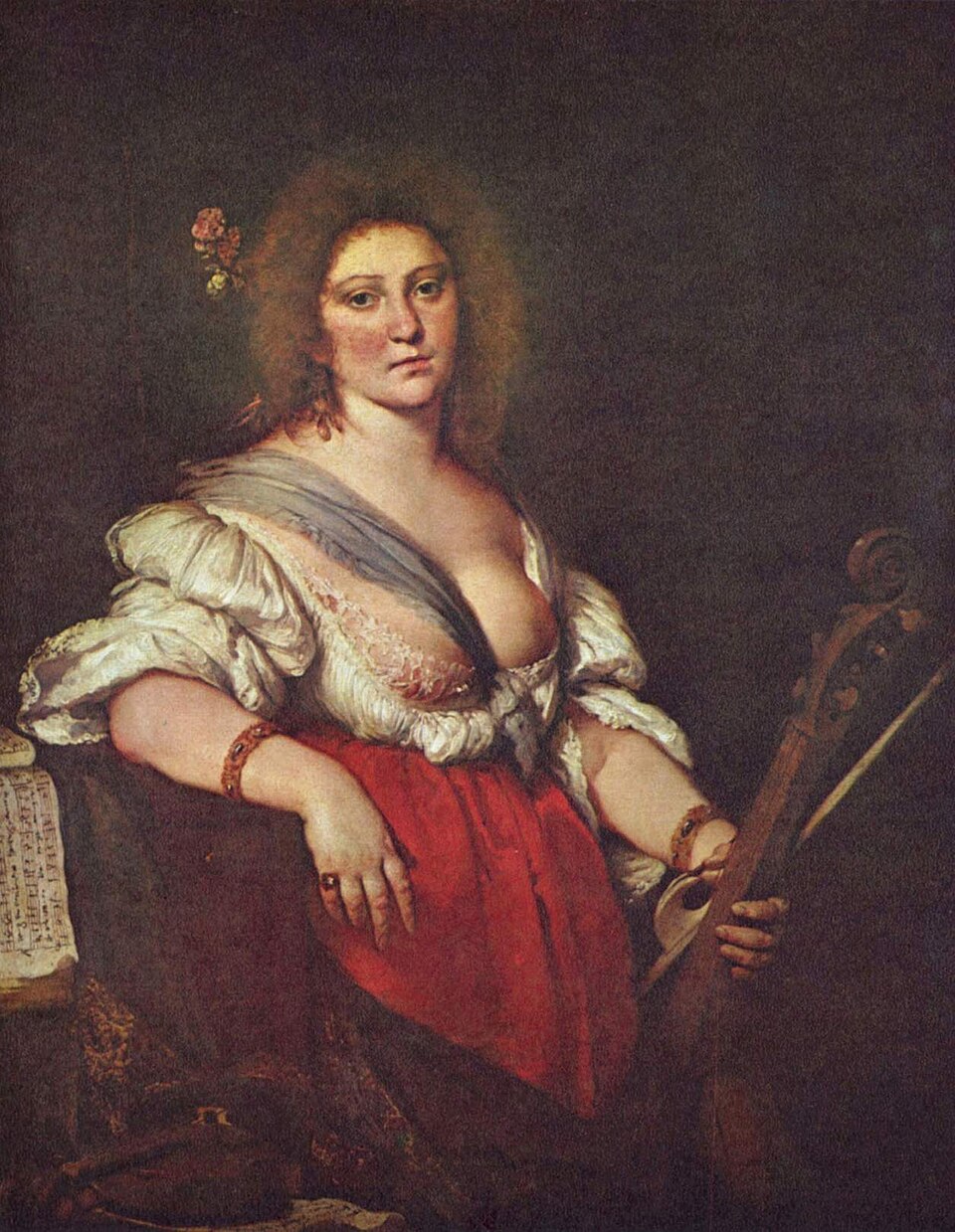
Barbara Strozzi · Baroque
1619 – 1677
1644 · Madrigals from 2 to 5 voices and continuous · Venice
Tonality
Without a unique tone. It's a collection of madrigals and everyone has his own.
Instruments
- Continuous low
From the atril
At the age of 25, Barbara Strozzi presented herself to the world with a book of madrigales, the most demanding genus of her time, and did so almost in the family: all the texts are by Giulio Strozzi, her adoptive father. In the dedication to Vittoria della Rovere, great Duchess of Tuscany, asks for protection «that it may not fall under the rays of evil»: A woman who published music in 1644 knew they were going to look at her with magnifying glass.
From the continuum, the most surprising thing is how theatrical it is. The voices are not limited to weaving counterpoint: they are interrupted, they dialogue and they are thrown into ornate passages that give away a singer who knew exactly what a throat can do. There is a lot of Monteverdi school, but with a freshness of its own, almost of conversation of the Venetian hall. He asks for agile singers and a flexible continuous bass, capable of breathing with the text.
What to hear
- Like keywords («love», «die», «sospiri») always receive a harmonic twist or unexpected ornament.
- The dialogues between acute voices, which sound more like an opera scene than a Renaissance madrigal.
- The role of the continuum, which not only accompanies but also pushes and comments on what the singers say.

