Today 24 / 11 was born
- Modest Musorgski · 1839, 187 years ago
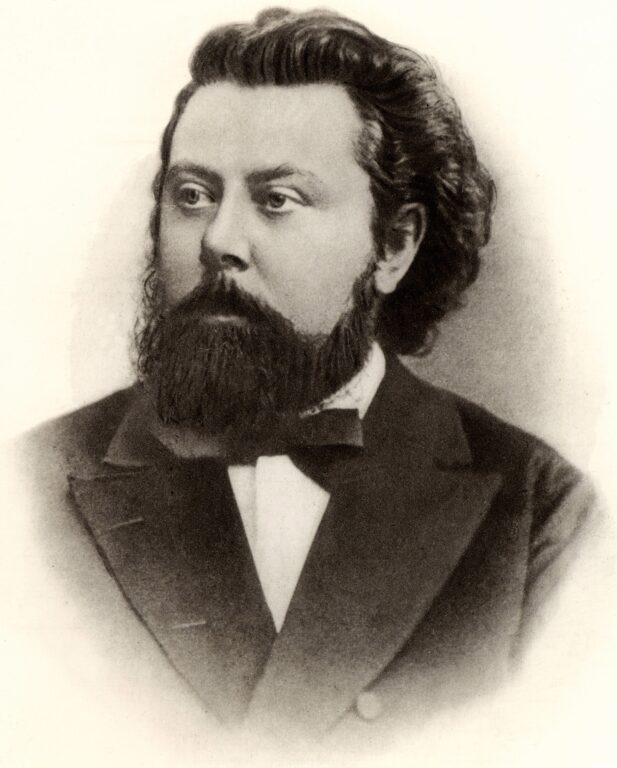
Romanticism · Russia
1839 – 1881
Karevo, Russia → St. Petersburg
Life
Modest Musorgski (also written Mussorgsky) was born on March 21, 1839 in Karevo, in the province of Pskov, in a family of landowners. His mother gave him the first piano classes and the nannies told him the Russian popular stories that would later feed his music. He followed the military career and entered the regiment of the Guardia Preobrazhenski, where he met Borodin; shortly after, the encounter with Dargomizhski and Mili Balákirev decided to leave the army in 1858 to engage in music. Along with Balákirev, Borodin, Rimski Korsakov and César Cui formed the Group of Five, committed to creating a truly Russian music.
Almost self-taught, with the abolition of servitude in 1861 his family lost much of his property and had to earn a living as an official. Yet it was the most original of the Five: it sought a music that followed the natural intonation of the Russian language and portrayed the people without ornaments, with rough harmonies that astonished and disconcerted their contemporaries. His opera Boris Godunov, rejected in a first version, premiered at the Mariinski in 1874, the same year he composed Tables of an exhibition in memory of his friend the painter Viktor Hartmann.
His last years were marked by loneliness, poverty and alcoholism. He died in a military hospital in St. Petersburg on March 28, 1881, a week after he was forty-two years old, a few days after Iliá Repin painted his famous portrait. He left many unfinished or unpolished works that Rimski Korsakov completed and reviewed. The orchestration of Tables of an exhibition Ravel made it in 1922 as one of the most popular works in the repertoire.
His music is one of the most original of the 19th century: he wanted to reproduce the intonation of Russian speech and portray real life without ornaments, with rough harmonies and free forms that disconcerted his contemporaries. Rimski Korsakov reviewed and pulsed many of his works after his death, and Ravel orchestrated the Tables of an exhibition. Today the strength of its original versions, which influenced Debussy and the music of the 20th century, is again appreciated. These are his main works:
I can INTEREST you.


