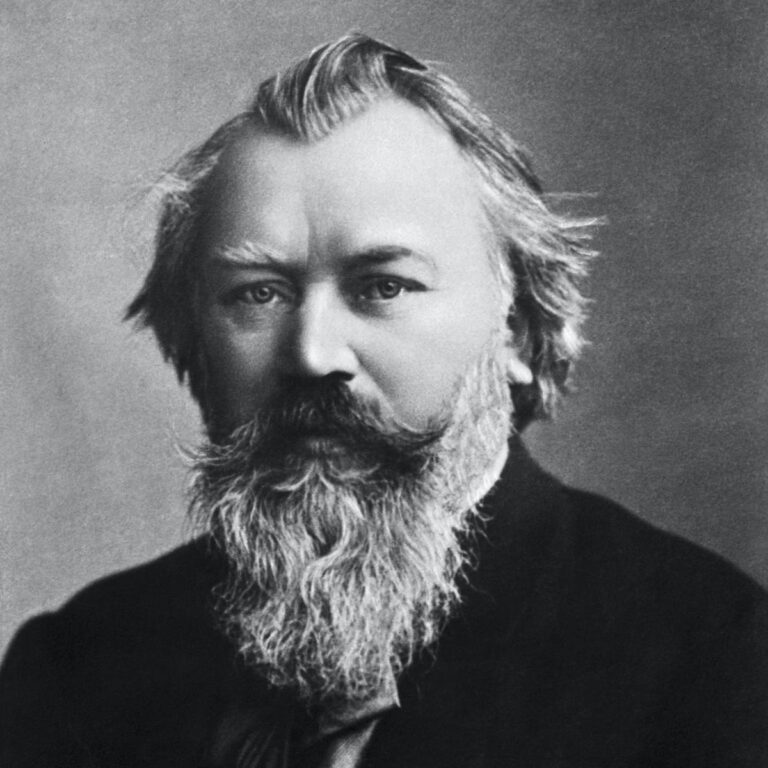
Johannes Brahms · Romanticism
1833 – 1897
1885 · Symphony · Meiningen
Tonality
From the atril
The Fourth, premiered in Meiningen in 1885, is the last symphony of Brahms and for many the largest. It is an autumn work, serious, in my minor, that looks to the past with wisdom: Brahms, a great connoisseur of ancient music, was inspired by a Bach cantata for his last movement.
The first movement begins without introduction, with a theme that seems to sigh, built on a chain of third descent. The walker has an archaic, almost modal color, which evokes an ancient ballad. The third movement is a robust and festive scherzo, with triangle, the only one of Brahms' symphonies. And the end is a passaglia: thirty variations on a theme of eight bars that is repeated without ceasing, a baroque form that Brahms turns into an relentless drama. The variation of the soloist flute, slow and desolate, is one of the most moving moments in the repertoire.
What to hear
- The theme of the first movement.
- The scherzo with triangle.
- The final passaglia and the flute solo.

