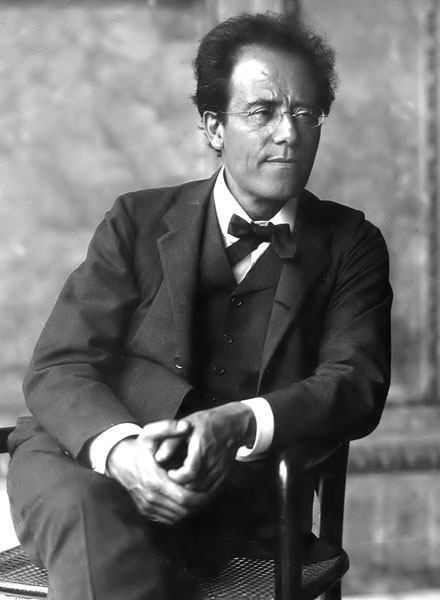
Gustav Mahler · Romanticism
1860 – 1911
1902 · Symphony with contralto and chorus · Krefeld
Tonality
Minor re. The long way of the work leads to a slow and bright end in major.
From the atril
Mahler composed the Third one between 1893 and 1896, during his summers in Steinbach, on the banks of Lake Attersee, in a small work cabin in front of the mountains. When Bruno Walter came to visit and stared at the landscape, Mahler told him that it was not necessary: he had already put everything in his music. It was released by himself in Krefeld in June 1902, with great success. With its six movements and about a hundred minutes, it is the longest symphony in the usual repertoire.
I can INTEREST you.

Mahler thought of the work as a ladder of creation, from inert nature to love, and came to give titles to each movement, though he then withdrew them. The first, huge, portrays the awakening of Pan and the arrival of summer, with marches, fanfare and a large single of thrombon. They follow a delicate minute on the meadow flowers and a scherzo on the forest animals, in which a cornet of posta sounds far away. In the room, the contralto sings the «midnight song» of the This is how Zaratustra spoke. of Nietzsche; in the fifth, a chorus of children imitates bells and a chorus of women sings a song of Des Knaben Wunderhorn. The end, an adage only for orchestra that Mahler associated with love, slowly grows to a solemn and serene conclusion. For the orchestra it is a test of resistance and concentration.
What to hear
- The call of the eight tubes that opens the symphony.
- The far-off cornet of the third movement.
- The final adagio, which grows to the last chords in greater re.
Listen
Mahler: 3. Sinfonie − hr-Sinfonieorchester − Andrés Orozco-Estrada · hr-Sinfonieorchester - Frankfurt Radio Symphony
When you press the YouTube player will be loaded.

