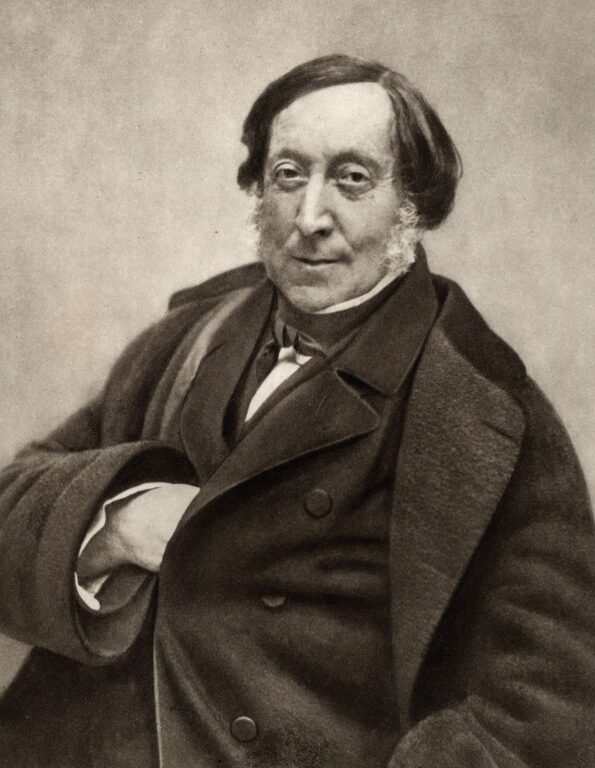
Gioachino Rossini · Romanticism
1792 – 1868
1842 · Solists, chorus and orchestra · Paris
Tonality
Without a unique tone. Its different parts go through several tonalities.
From the atril
Rossini started his Stabat Mater in 1832 on the order of a Spanish cleric, and since he was sick he let his friend Giovanni Tadolini write some numbers. Years later, knowing that this version was going to be published, he replaced the music of others with his own. The complete work was released in Paris in January 1842 with a huge success.
I can INTEREST you.

It's sacred music written by a theatre man, and that divided the critics of the time. Some numbers seem to be opera arias, like the «Cujus animam» for tenor, with its joyful melody and its sharp, so brilliant re-bemol that it seems to forget that the text speaks of the pain of the Virgin. But there are also moments of great recollection, like the «Quis est homo» for two sopranos or the chorus to cappella «Eja, Mater»and a final escape of great force. For soloists it's a belcanto festival.
What to hear
- The «Cujus animam» of the tenor.
- The soprano duo «Quis est homo».
- The final leak «In sempitera saecula».

