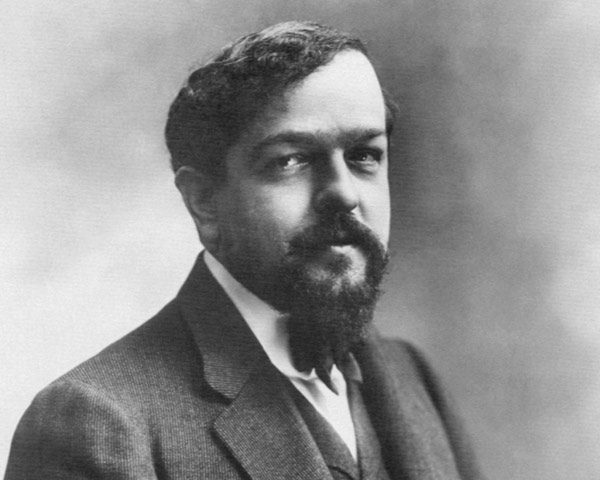
Claude Debussy · Impressionism
1862 – 1918
1905 - 1907 · Two series of three pieces for piano · Paris
Tonality
Without a unique tone. It's two three-piece series and each has his own.
From the atril
Debussy was convinced that with these pieces he had found a new place in the history of the piano, «to the left of Schumann or to the right of Chopin»He wrote to his editor. It's two series of three pieces each. The first contains Refluses dans l'eau, Hommage à Rameau and Mouvement; the second, Coches à travers les feuilles, Et la lune descend sur le tempe qui fut and Poissons d'or.
For the pianist they are a universe of colors. Refluses dans l'eau It evokes the reflections that deform on the surface of a pond when a stone falls, with waves that expand throughout the keyboard. Hommage à Rameau is a serious and noble sarabanda in homage to the great French Baroque composer. In the second series, Debussy first writes in three pentagrams to be able to score its sound layers, and Poissons d'orinspired by a Japanese lacquer, it is a virtuous flare of fish that slip away.
What to hear
- The reflections that expand in Refluses dans l'eau.
- The noble sarabanda of Hommage à Rameau.
- The flashes of Poissons d'or.
Listen
Debussy: Images pour orchestre (National Orchestra of France / Emmanuel Krivine) · France Musique concerts
When you press the YouTube player will be loaded.

