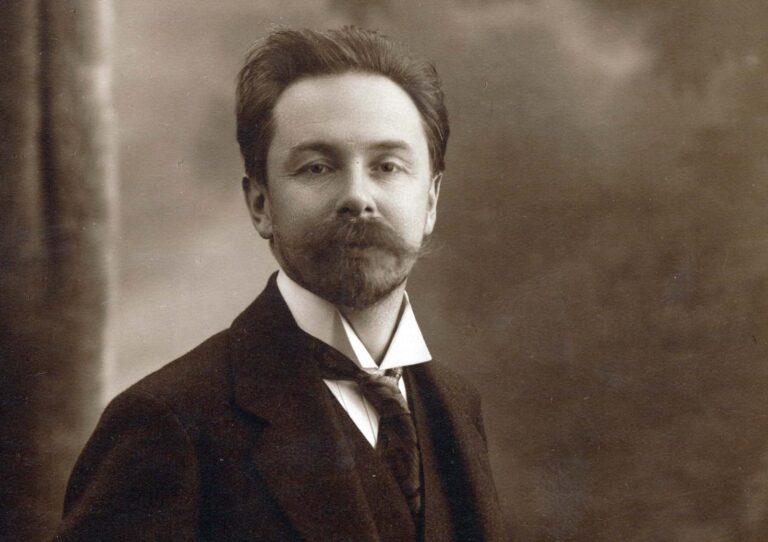
Alexander Scriabin · Impressionism
1872 – 1915
1904 · Great orchestra · Premiere in Paris, 1905
Tonality
Do minor. The work ends in a radiant major.
From the atril
With this symphony Scriabin takes the leap to his philosophical world. His three movements, which are played without pause, carry titles in French: Luttes (CHUCKLES) Volume (Volume) and Jeu divin (Divine game). They describe, according to the program he wrote with his partner Tatiana Schloezer, the liberation of the human spirit, which is derived from the past and reaches the joy of a free creation.
In the orchestra it is a huge score, very Wagnerian still in its density. It begins with a solemn motive of the serious metals, to which the trumpet responds with a call that returns again and again, as the affirmation of the self. The second movement is pure sensual ecstasy, with bird songs on the woods and a rope that seems to never stand. For metals it is demanding and exhausting, but when the end sounds, radiant, it is understood that Scriabin was looking for more than music.
What to hear
- The trumpet call that states the «I» divine.
- The bird songs of Volume.
- The radiant end of Jeu divin.

