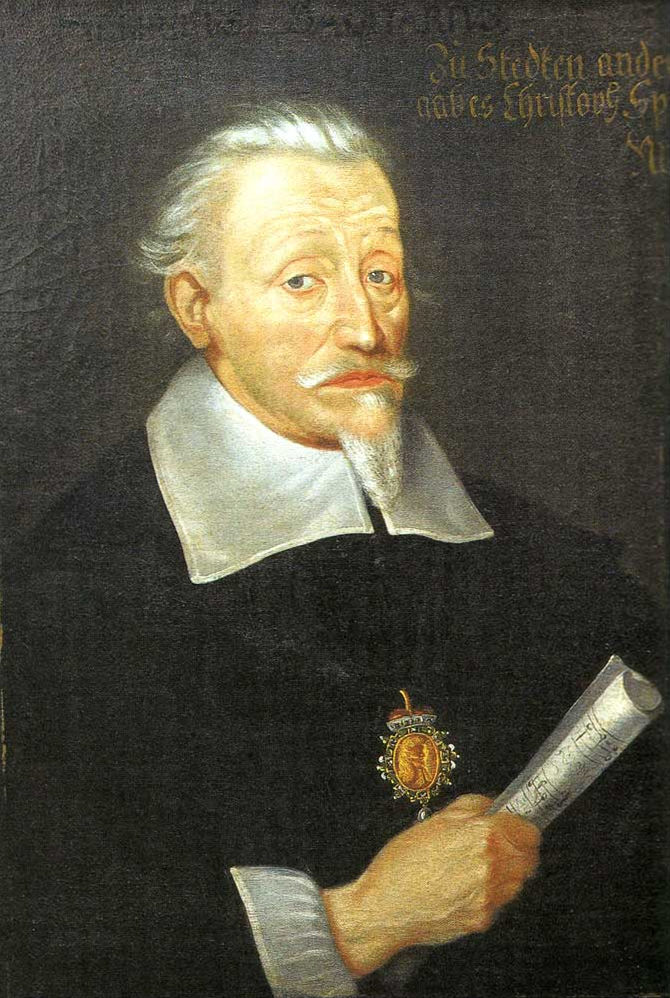
Heinrich Schütz · Baroque
1585 – 1672
1611 · 5-voice Madrigals · Venice
Tonality
Without a unique tone. They are nineteen madrigals written in the modal language of the time, and each has its own center.
Instruments
- Five unaccompanied voices in almost every madrigal.
- Eight voices with continuous bass in the final madrigal.
From the atril
This book of madrigals is Schütz's final examination in Venice. The landgrave Moritz of Hessen-Kassel had paid him the studies with Giovanni Gabrieli, and the young German returned the favor by publishing in 1611 his opus 1: a collection of Italian madrigals to five voices on poems of Guarini and Marino, among others.
I can INTEREST you.

It is amazing that a 25-year-old alien thus dominates the most refined genus in Italy of his time. Schütz paints every word: sigh with silence, pain with dissonances, joy with fast figures that jump from voice to voice. There are harmonic audacity that reminiscent of Monteverdi and a sense of counterpoint that already announces to the great sacred composer that will be. He never wrote profane madrigals again, but everything he learned here about putting music in the text took him to German.
What to hear
- «O spring», that opens the collection.
- The most painful madrigals, full of expressive disonances.
- The eight-voice dialogue that closes the book.
Listen
Heinrich Schütz - Il primo book by Madrigali, SWV 1-19 (1611) [Italian Madrigals] · A petit abreuvoir
When you press the YouTube player will be loaded.

