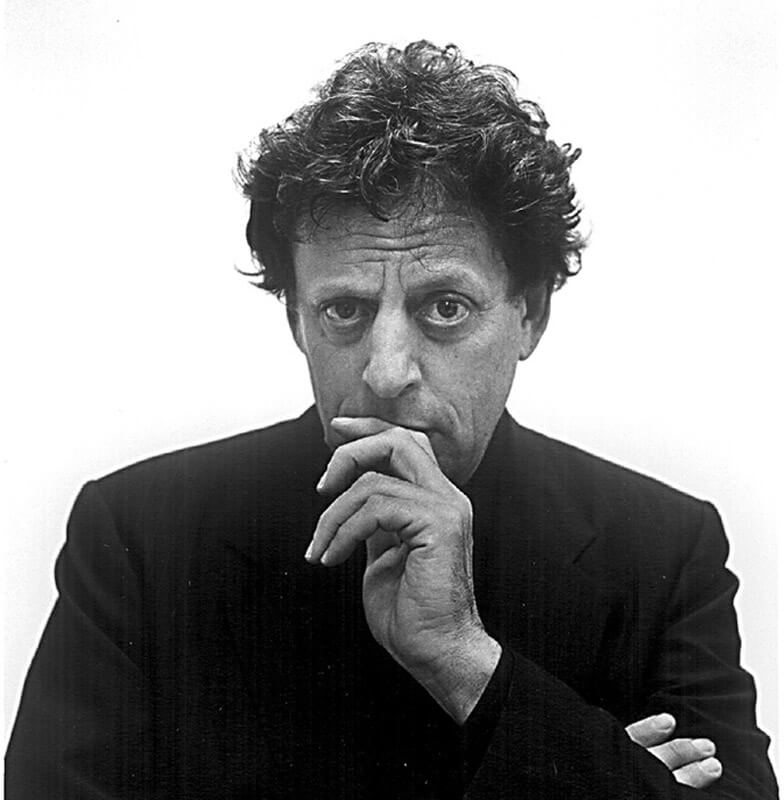
Philip Glass · Minimalism
n. 1937
1976 · Opera · Avignon
Tonality
Without a unique tone. The music advances on a few progressions of chords that are repeated and transformed for hours.
Instruments
- Amplified organs and synthesizers
- Flutes, saxophone and low clarinet
- Solo violin
- Solo soprano and chorus
- Voices spoken
From the atril
Philip Glass and stage director Robert Wilson released it at the Avignon Festival in 1976. It has no argument or characters in the classical sense: it is a succession of images inspired by the figure of Albert Einstein, with trains, a trial, a spaceship and a violinist who remembers the scientist, who played the violin. It lasts about four and a half hours without rest, and the public can enter and leave the room whenever they want. The scenes are linked to short intermedials called Knee Play, «joints» of the play.
The choir does not sing a text, but numbers and note names: «one, two, three, four» or «do, re, mi»They serve to mark the rhythms. The spoken voices recite texts by Christopher Knowles, Lucinda Childs and Samuel M. Johnson. For musicians it is a challenge of resistance and concentration, because having with precision hundreds of almost identical repetitions requires absolute attention. It was the work that launched Glass and changed the idea of what an opera could be.
What to hear
- The choir that sings numbers on the first Knee Play.
- The violin solo from the violinist scene.
- The final scene of the spacecraft, full volume.
Listen
Philip Glass - Einstein on the Beach · Classical music
When you press the YouTube player will be loaded.

