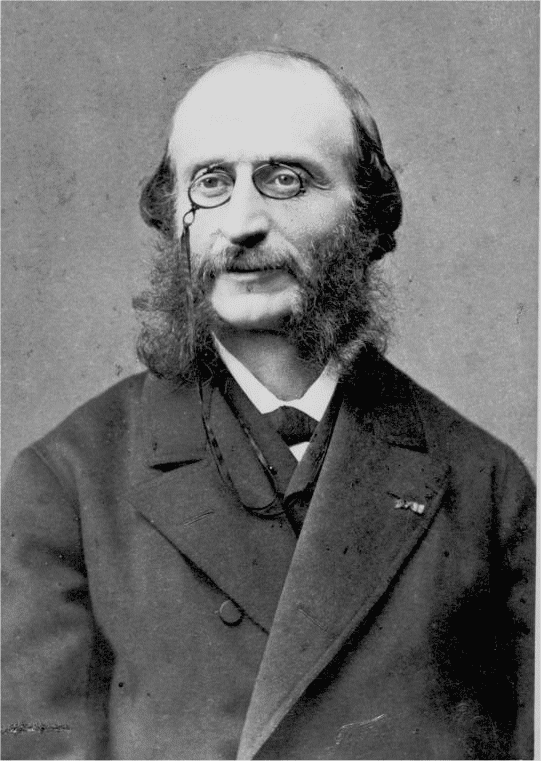
Jacques Offenbach · Romanticism
1819 – 1880
1858 · Opera · Paris, Bouffes-Parisiens
Tonality
Without a unique tone. Like every stage work, it goes through many tonalities throughout its numbers.
From the atril
In 1858, in the small theatre of Offenbach, the Bouffes-Parisiens, with a libretto by Hector Crémieux and Ludovic Halévy, is the first great French opera and a brazen mockery of the most sacred myth of the opera. Here Orpheus is a professor of heavy violin and Euridice is delighted to get rid of him; only the «Public opinion», a character with the air of a governess, forces the husband to go down and look for her. Meanwhile, the Olimpo gods are bored and Jupiter becomes a fly to seduce Eurydice.
I can INTEREST you.

Offenbach parody Gluck citing his famous Aria of Orpheus's lament, but what everyone remembers is the «Inland galop» of the feast in the hell: a whirlwind in two by four that passed into history as the caravan. For the orchestra it is pure adrenaline, with a tempo that does not forgive. The oberture that is usually played in concert, with its violin and cello solo, is not from Offenbach as it is: it was mounted by Carl Binder for the premiere in Vienna in 1860.
What to hear
- The «Inland galop»The most famous caravan.
- The fly duo between Jupiter and Eurydice.
- The parody of Gluck's aria.

