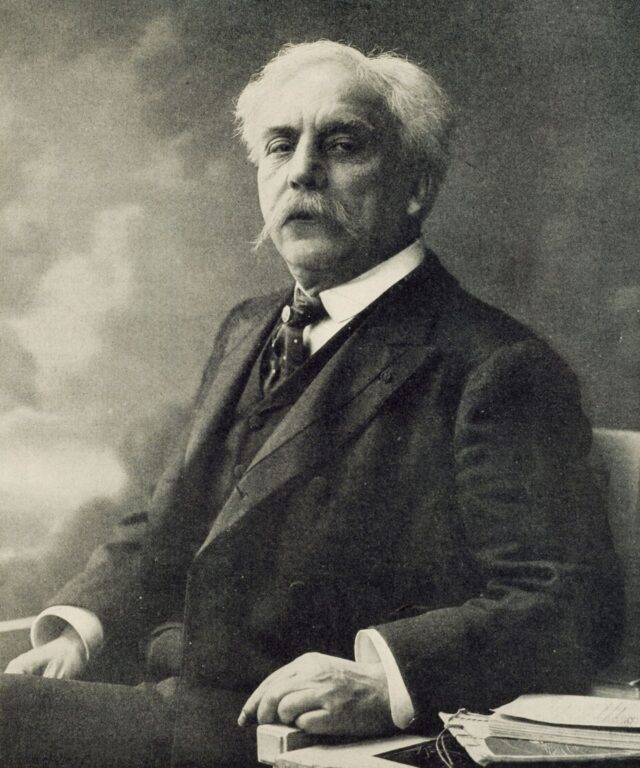
Gabriel Fauré · Romanticism
1845 – 1924
1898 · Accidental music · London
Tonality
Without a unique tone. It's a suite of several numbers and everyone has his own.
From the atril
In 1898, actress Mrs. Patrick Campbell commissioned Fauré to have the music for a London performance of the Symbolist drama of Maeterlinck, in English translation. In a short time, Fauré wrote the music and entrusted part of the orchestration to his student Charles Koechlin. He then gathered the best numbers in a concert suite, which is what is known today.
I can INTEREST you.

The suite has four movements: a prelude full of mystery, «The filet»in which the strings imitate the turn of the wheel, the famous «Sicilienne», with his flute melody on the harp, and «The Mélisande mort», a lament of great sobriety. It is music of atmosphere, of tenuous colors and veiled emotions, very close to the world of Maeterlinck. For the orchestra it requires delicacy and transparency; for the flautist, the «Sicilienne» It's a reference solo.
What to hear
- The wheel of the strings in «The filet».
- The flute and the harp of the «Sicilienne».
- The sober «The Mélisande mort».

