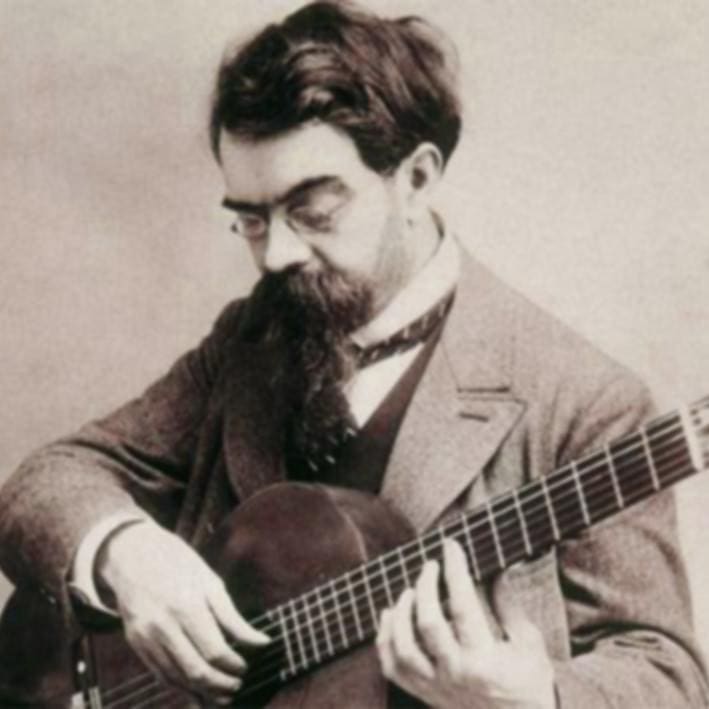
Romanticism · Spanish nationality
1852 – 1909
Vila-real (Castellón) · Barcelona
Bio
Francisco Tárrega was born in Vila- real on November 21, 1852. As a child, he suffered a fall in a waterfall that left his eyes damaged forever, and his father, afraid he could not make a living otherwise, directed him to music. He learned guitar and piano, and very young already played in cafés and meetings in Castellón and Valencia.
With the support of a Spanish patron, he entered the Conservatory of Madrid in 1874, where he studied piano, harmony and composition. There he made a rare decision for the time: to devote himself completely to the guitar, an instrument then considered minor in the concert rooms. His guitar by Antonio de Torres, the great almerian builder, gave him the sound and power he needed.
During the 1880s and 1890, he acted throughout Spain and in cities like Paris and London, and in 1885 he settled in Barcelona, which would be his home until the end. There he trained a generation of guitarists —Miguel Llobet, Emilio Pujol, Daniel Fortea or Josefina Robledo— they would spread their school all over the world. In 1906 a paralysis affected his right arm; although he recovered in part, his last years were difficult. He died in Barcelona on December 15, 1909.
His music
Tárrega is considered the father of the modern classical guitar. He fixed the instrument's position on the left leg with foot support, developed the supported pulsation to give more body to the sound and led the trémolo to an unknown expressiveness until then.
I can INTEREST you.

His original work is brief, intimate and deeply romantic: mazurcas, waltz, prelude and studies of great lirism, along with pieces of Andalusian and Moorish flavor that place him next to Albéniz and Granados in Spanish nationalism. In addition, he expanded the guitar repertoire with more than a hundred transcripts from Bach, Beethoven, Chopin, Schumann, Mendelssohn and from Albéniz himself.
Featured works
- Memories of the Alhambra (1896 - 44 years old) — Trémolo study inspired by his visit to Granada
- Arab capricho — serenade dedicated to Tomas Breton
- Tear — prelude written in London, longing for Spain
- Adelita — mazurca
- Marieta — mazurca
- Danza mora
- Great waltz — whose melody turned the world around as a mobile phone tone
- Bright study (on a study by Delphin Alard)
- Endecha and Oremus — preludes
- Big jack.

