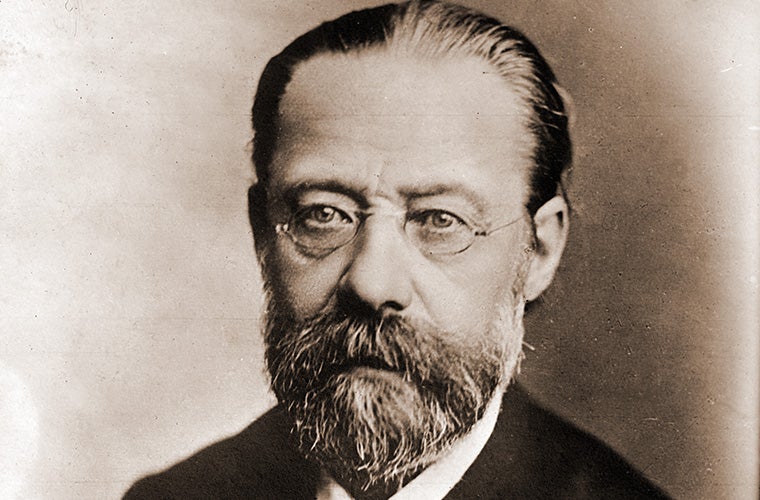
Bedrich Smetana · Romanticism
1824 – 1884
1868 · tragic opera · Prague
Tonality
Without a unique tone. Like every opera, he goes through many tonalities throughout his scenes, arias and chorus.
From the atril
It premiered in 1868, the same day that the first stone of the Prague National Theatre was placed, a patriotic event of first magnitude. It tells the story of the gentleman Dalibor, imprisoned in a tower of the castle of Prague, and of Milada, who is disguised as a man to free him. Parallel with Fidelium of Beethoven is evident, and legend says Dalibor learned to play the violin in his prison.
I can INTEREST you.

Some critics of the time accused Smetana of «Wagnerian», and there is something: the orchestra is dense, the themes become transformed throughout the work and the discourse is more continuous than in its other operas. For a violinist it has a beautiful detail: Zdeněk's violin, Dalibor's dead friend, becomes a symbol and appears in a single violin of great beauty. It's a dark, heroic opera that deserves to get out of Czech.
What to hear
- The violin solo, I remember the friend Zdeněk.
- Dalibor's monologue in prison.
- The dense orchestration that earned Smetana the label of «Wagnerian».

