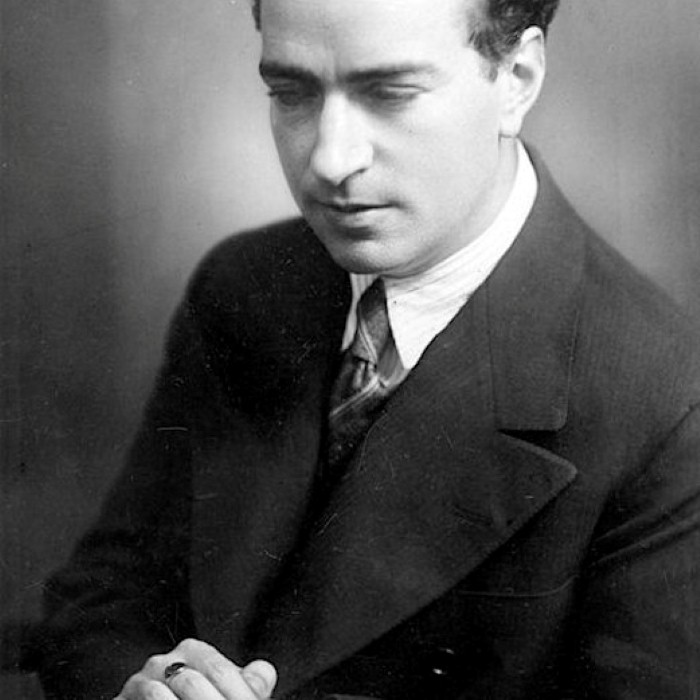
Joaquín Rodrigo · Impressionism
1901 – 1999
1939 · Concert for guitar · Barcelona
Tonality
Major. The famous Central Adagio is in if minor.
Instruments
- Solista: guitar.
- Timber: 2 flutes (the second also flautin), 2 oboes (the second also English corno), 2 clarings and 2 fages.
- Metals: 2 tubes and 2 trumpets.
- Rope: violins, violas, cello and contrabajos.
From the atril
Rodrigo wrote the Aranjuez concert in Paris in 1939, at the suggestion of guitarist Regino Sainz de la Maza, and finished it back in Spain. It premiered on November 9, 1940 at the Palau de la Música Catalana in Barcelona, with Sainz de la Maza as a soloist and the Barcelona Philharmonic Orchestra directed by César Mendoza Lasalle. It was an immediate success and is probably the most widely interpreted 20th-century Spanish work in the world.
The great challenge was that the guitar, an instrument of little volume, could dialogue with an orchestra. Rodrigo solved it with a very careful orchestration, which lets the soloist breathe. The concert evokes the gardens of the palace of Aranjuez in times of the Bourbons, with the gallant air of the 18th century and popular rhythms. His heart is Adagio: the English corno sings a melancholic melody on the guitar's scratches, on one of the best known pages of classical music. The composer said he was linked to a very painful moment in his life and that of his wife, Victoria Kamhi.
What to hear
- The scratches that open the Allegro with spirito.
- The dialogue between English corno and guitar in Adagio, and the cadence of the soloist.
- The final gentle Allegro, with his courtesan rhythm.

