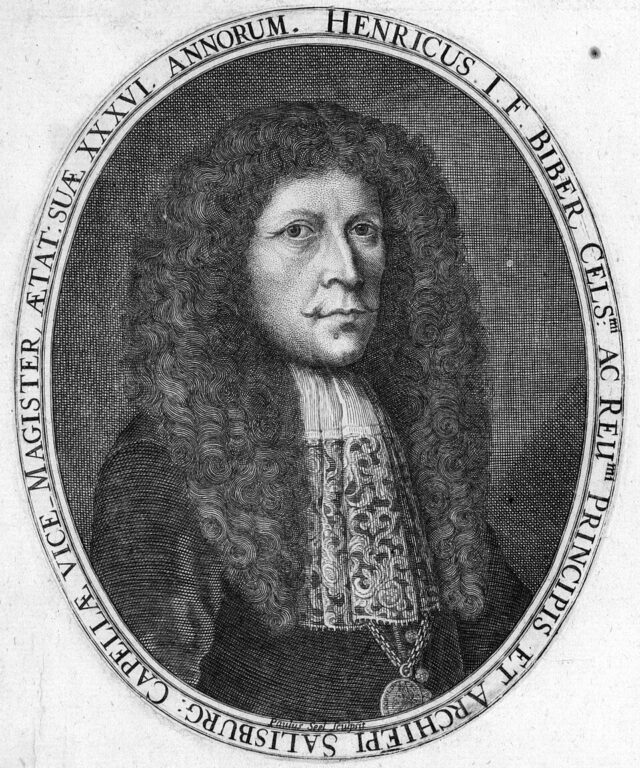
Heinrich Ignaz Franz Biber · Baroque
1644 – 1704
c. 1676 · Violin and continuous · Salzburg
Tonality
Without a unique tone. There are fifteen sonatas and one final passaglia, each in its tone and almost all with a different tuning of the violin (scordature).
Instruments
- Violin (with different tunings, string, in almost every sonata)
- Continuous low
- The final passaglia, for violin alone
From the atril
To the Sonatas del Rosario, also calls «of the Mysteries», are fifteen sonatas for violin and continuous, one for each mystery of the rosary, from the Annunciation to the Coronation of the Virgin. In the manuscript, each is preceded by a small engraving of the scene. They remained almost unknown until its publication in 1905, and today they are one of the summits of the Baroque violin.
Its great singularity is the string: except for the first one, each sonata requests a different tuning of the strings, which completely changes the resonance of the instrument and forces the violinist to read notes that do not sound like they are written. At the Resurrection, Biber comes to ask that the two central cords be crossed behind the bridge, as a symbol of the cross. The cycle is closed with a Passacaglia for violin alone, in normal tuning, on a bass of four descending notes: an intimate meditation that is, for many, the direct antecedent of the Bach Chacona.
What to hear
- The Sonata I, «The Annunciation»with his prelude of arpegios.
- The Sonata XI, «The Resurrection»with the strings crossed.
- The final Passaglia for violin alone.

